


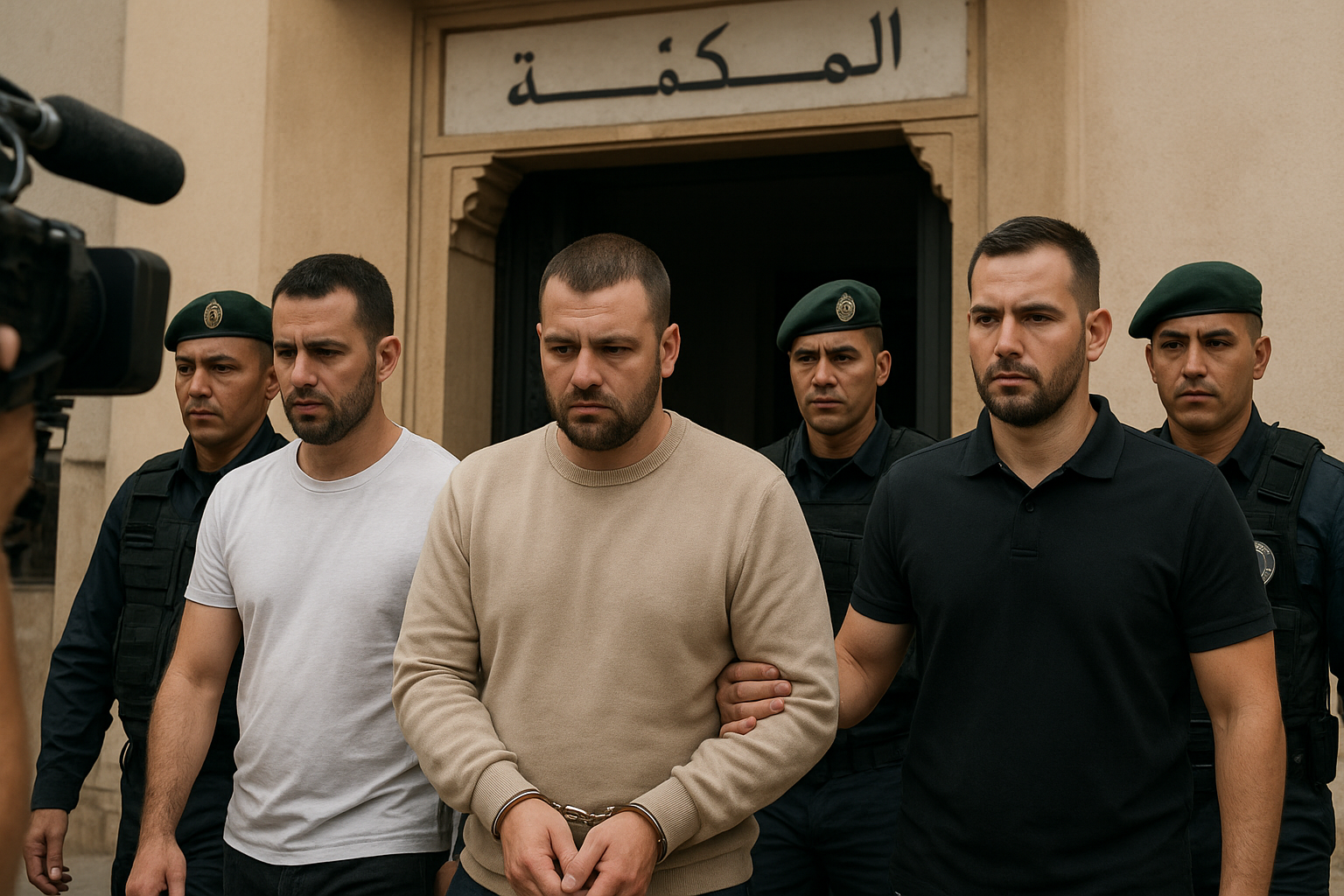
This update focuses on Antwerp fugitives sentencing. The recent sentencing of several Antwerp fugitives linked to drug trafficking in Marrakech is raising questions among Moroccans living abroad about whether border controls and travel conditions to Morocco are changing.
What we know about the Antwerp fugitives sentencing
According to information reported in Belgium, three men from Antwerp’s drug scene were arrested in Marrakech in June, after spending several years on the run from Belgian justice.
Abdelilah “Black” El Messaoudi, 42, Moraad “Glamourboy” El Kasmi, 35, and Mohamed “Kikker” Benhaddou, 47, were unexpectedly transferred from prison to a court in Marrakech last Thursday, alongside several other defendants, including French and Dutch nationals.
On the same day, the court is reported to have handed down prison sentences ranging from five to nine years. The Moroccan proceedings concern offences allegedly committed in Morocco, including suspected money laundering and participation in a criminal organisation, and are not directly linked to the Belgian cases or to the international arrest warrants issued against the three men.
Sources close to the defendants say they intend to appeal. Another hearing could take place in September to clarify what comes next and how, if at all, the Belgian convictions might be taken into account.
Closer judicial cooperation, not new rules for ordinary travellers
For Moroccans abroad, the Antwerp fugitives sentencing is first and foremost a reminder that drug networks exploiting routes between Europe and Morocco are under tighter scrutiny.
In concrete terms, this case does not, at this stage, change the basic entry and exit rules for ordinary travellers. No official update has been issued on travel conditions by air or sea between Europe and Morocco.
However, it does confirm trends that were already visible:
- Closer cooperation between European and Moroccan authorities on organised crime cases.
- Particular attention to individuals who are already flagged or subject to arrest warrants.
- More systematic use of information-sharing tools between police forces.
For the vast majority of Moroccans living abroad, who travel with valid documents and have no criminal record, this tougher approach is designed to secure travel flows, not to make them harder.
Planning a trip to Morocco: what you should actually check
In this context, a few basic checks remain useful when preparing a trip to Morocco, especially during peak holiday periods or family returns.
Before travelling, it is advisable to:
- Check that your passport, and your residence permit in your country of residence if applicable, are still valid.
- Confirm travel conditions with your airline or ferry company, for instance via the Royal Air Maroc website for flights.
- Avoid carrying large amounts of cash without clear supporting documents.
- Refuse to transport luggage or parcels for third parties you do not know well.
Screening procedures can be longer on some routes considered sensitive, for example between European cities associated with major drug cases and Moroccan tourist hubs such as Marrakech. Yet these measures remain targeted and focused on specific profiles.
For Belgian Moroccans: a case to watch, procedures unchanged
The three men sentenced in Marrakech are already well known to the courts in Antwerp, with heavy records for cocaine trafficking and money laundering. One has accumulated more than thirty years of prison sentences in Belgium, another is involved in a major narcotics case, while the third still has several years to serve for drug trafficking and laundering via a former bar business.
For Belgian Moroccans, and more broadly for European citizens of Moroccan origin, this case is a reminder that having ties on both sides of the Mediterranean can be exploited by criminal networks looking for intermediaries and hiding places.
That said, there has been no announcement of any general measures targeting Belgian Moroccans as travellers. The usual steps for a stay in Morocco remain unchanged: booking tickets, passing border checks with a valid passport, and going through standard customs and police procedures.
If you have a specific concern about your personal situation (similar name to a wanted person, an old case fully settled, lost or stolen documents), it is wise to contact the nearest Moroccan consulate in your country of residence before travelling, and to check travel information with your carrier and on official websites.
Behind the striking nicknames and heavy sentences, the Antwerp fugitives sentencing mainly shows that the fight against drug-related networks is now coordinated on both shores of the Mediterranean, without changing the daily reality of law-abiding travellers for the moment.
Useful resources for your next trip
To prepare your next trip or return to Morocco, you can consult our practical guide to key procedures for Moroccans living abroad, as well as updates from airlines and Moroccan authorities.
For more context, readers can follow Canal212 news for Moroccans abroad.
Don’t miss out on the latest news from the diaspora!
Sign up for our next newsletter to receive our practical guides, advice (on procedures and investment) and the latest news for French nationals living abroad, delivered straight to your inbox.