


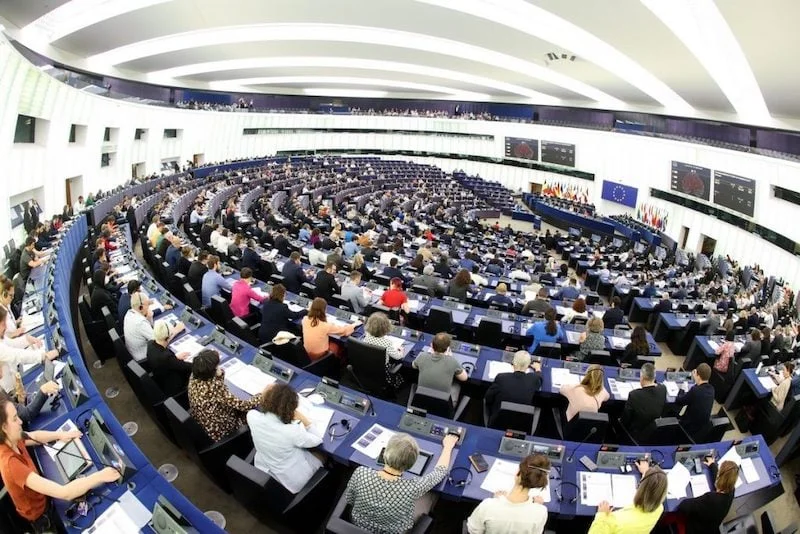
The European Parliament Ceuta debate over migrant returns is once again putting political pressure on Rabat and Madrid, but without any immediate consequences for the regular travel of Moroccans living abroad.
What the new Ceuta resolution actually says
On Thursday, Members of the European Parliament adopted a political resolution targeting the mass crossing of migrants into Ceuta at the end of July from northern Morocco. The text calls on Morocco and Spain to strengthen their cooperation in order to speed up the return of foreigners who entered the enclave.
This resolution has no binding legal force. It does not create new laws and does not change the rules for entering the Schengen area. It is a political signal, driven by the centre-right European People’s Party (EPP) and backed by far-right groups.
Adopted by 339 votes to 225, with 16 abstentions, the text:
- condemns “mass and illegal border crossings” into Ceuta from Morocco, by land and sea;
- denounces the use of irregular migration as an “instrument of hybrid warfare” against an EU member state;
- reaffirms that Ceuta and Melilla are considered Spanish and European cities;
- demands respect for the territorial integrity of EU member states, in line with international law.
The resolution also calls on Morocco to assume its responsibilities in border management and migration cooperation.
European Parliament Ceuta move: a political signal, not a border shutdown
For Moroccans abroad, one key question arises: could this resolution make trips to Morocco or transits through Spain more difficult? For now, the answer is no.
The resolution:
- does not change visa requirements for Moroccan nationals;
- does not alter airport checks for regular travellers;
- does not target family visits, tourism, or business travel.
It strictly concerns irregular entries into Ceuta and the return of people with no legal right to stay in the EU. Moroccans travelling with a valid passport, a Schengen visa when required, or an EU residence permit are not the focus of this text.
However, the European Parliament Ceuta debate underlines a deeper trend: several political forces in Europe want to tighten the protection of the EU’s external borders, especially in the western Mediterranean.
What Moroccans abroad should watch in practice
So far, there has been no official change announced for air, sea, or road connections between Morocco and Spain. Airlines such as Royal Air Maroc, and ferry operators, continue to apply their usual travel and documentation rules.
In practice, Moroccans abroad can:
- keep booking flights and ferry crossings as usual;
- prepare documents (passport, visas, residence permits) with the same care as in previous years;
- monitor any official announcements if tensions rise between Rabat and Madrid.
Key elements to watch over the coming months include:
- any intensified bilateral talks between Morocco and Spain on migration;
- political statements in Spain, especially around election cycles;
- new EU projects to reinforce border surveillance, particularly around Ceuta and Melilla.
Sensitive border, essential mobility
Ceuta will remain a sensitive topic between Morocco, Spain, and some political actors in Brussels. But at this stage, the European Parliament Ceuta resolution does not call into question the legal mobility of Moroccan families, students, or investors.
To avoid unpleasant surprises, it is still wise to:
- systematically check Schengen entry conditions before each trip;
- rely on official airline and consular websites for updates;
- plan bookings earlier in peak seasons, when migratory pressure and border checks can tighten.
Debates in Brussels will continue, but for Moroccans abroad, the priority is clear: protect and facilitate regular mobility, while adapting to an increasingly sensitive European political climate on migration.
For more context, readers can follow Canal212 news for Moroccans abroad.
For official updates, readers can check the relevant official source.
Don’t miss out on the latest news from the diaspora!
Sign up for our next newsletter to receive our practical guides, advice (on procedures and investment) and the latest news for French nationals living abroad, delivered straight to your inbox.