

The growing gap between flattering official results and very weak skills is putting Moroccan school assessments under scrutiny, with concrete consequences for families and their children’s future projects.
A record 83.3% bac pass rate versus a bleak PISA picture
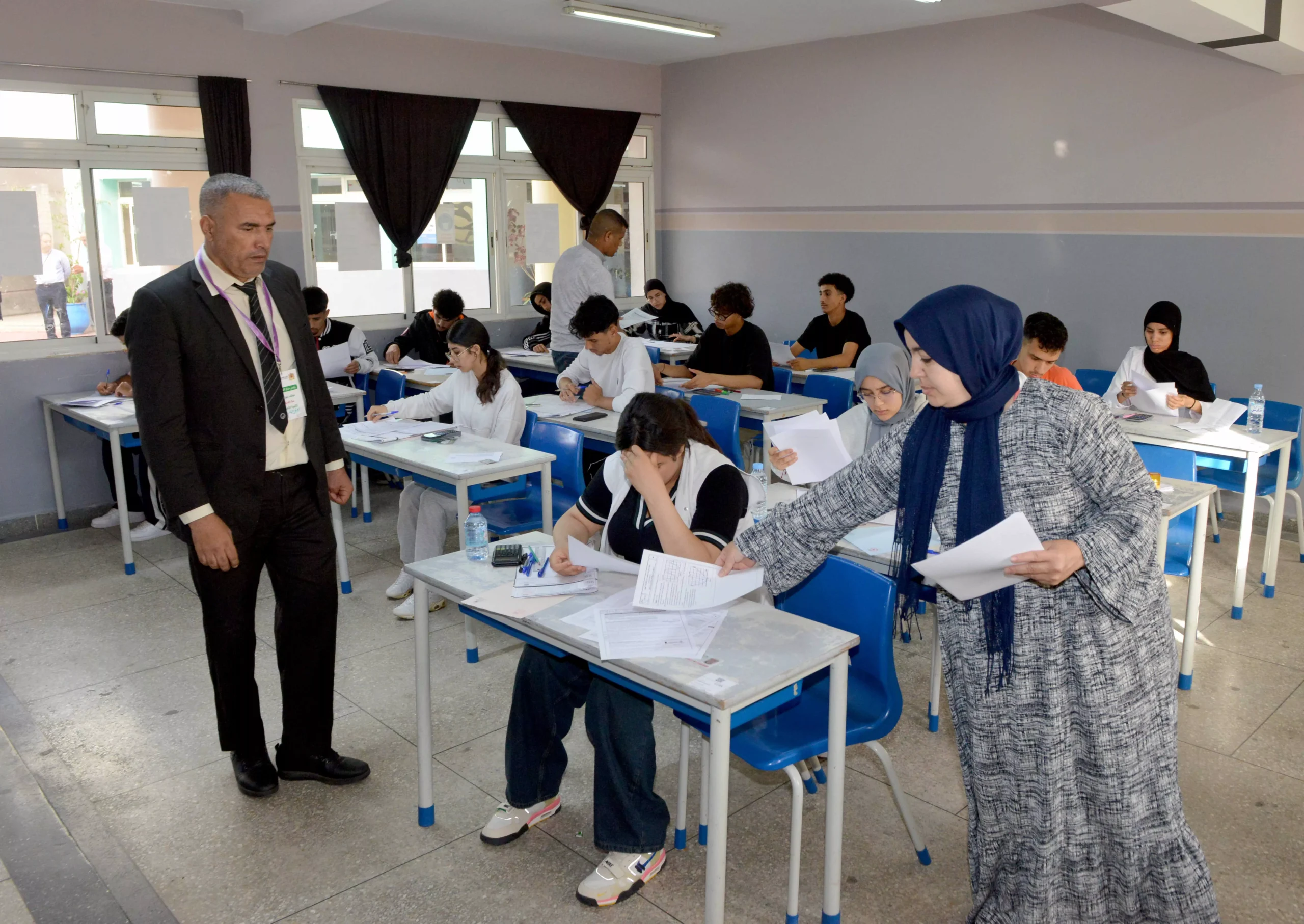
On 14 July 2025, Morocco announced a record baccalaureate pass rate of 83.3%. The figure was widely presented as a national success.
But only a few months earlier, the international PISA 2022 survey had painted a very different picture. According to that study, only a small share of 15-year-old Moroccan students reach the minimum skills in mathematics and reading.
This is not a minor discrepancy, but a wide gap. Abdennasser Naji, president of the Moroccan Association for the Improvement of Education Quality (AMAQUEN), describes it as a form of “statistical schizophrenia” affecting Moroccan schools.
A system of Moroccan school assessments disconnected from real learning
At the heart of the criticism lies a system of Moroccan school assessments that no longer truly reflects what students can actually do.
On one side, national exams such as the baccalaureate and the junior secondary certificate show rising success rates. On the other, major international surveys (PISA, TIMSS, PIRLS) consistently place Morocco near the bottom of global rankings.
This raises a crucial question: do national exams still measure real learning, or are they mainly validating school progression while expectations are quietly lowered?
Naji also highlights another weak link: the evaluation of schools themselves. This was supposed to be one of the main tools of the national education reform under framework law 51.17, yet it remains largely stalled. Without a clear and independent diagnosis of schools, it is difficult to know what works and what must change.
What this means for parents in Morocco and abroad
For families living abroad who are considering moving back to Morocco, or planning a long stay for their children, this “statistical schizophrenia” is not an abstract debate. It directly shapes their choices.
- Whether to enroll their children in the Moroccan public system after returning.
- Whether to opt for private or international schools, which are more expensive.
- How compatible Moroccan curricula are with host-country education systems.
If diplomas show high pass rates but real skills remain weak, students may struggle when entering foreign universities or moving again to another country. Moroccans living abroad therefore need to look beyond official figures.
Before returning, many already choose to:
- contact schools in Morocco directly to get first-hand information;
- compare curricula and teaching methods with those of the country where they live;
- plan possible extra tutoring or catch-up classes for their children.
In this context, reliable and transparent Moroccan school assessments become a strategic tool, both for policymakers and for families inside and outside the country.
Reforming assessments to rebuild confidence
AMAQUEN’s call stresses the need for deep reform: revisiting assessment methods, reinforcing the measurement of students’ skills, and effectively implementing school evaluations as required by framework law 51.17.
The key issue goes beyond statistics: it is about trust — trust from parents in the school system, trust from universities and employers in Moroccan diplomas, and trust from Moroccans abroad who are thinking about returning or investing in their children’s education back home.
To help with these decisions, practical resources already exist, such as Canal212’s guide to key procedures and benchmarks for preparing a return or a schooling project in Morocco, and the official portal of the administration in charge of Moroccans living abroad: www.mre.gov.ma.
The challenge now is to bring statistics, ambitions and classroom reality into line, so that every success printed on a diploma truly reflects solid skills.
For more context, readers can follow Canal212 news for Moroccans abroad.
Don’t miss out on the latest news from the diaspora!
Sign up for our next newsletter to receive our practical guides, advice (on procedures and investment) and the latest news for French nationals living abroad, delivered straight to your inbox.