


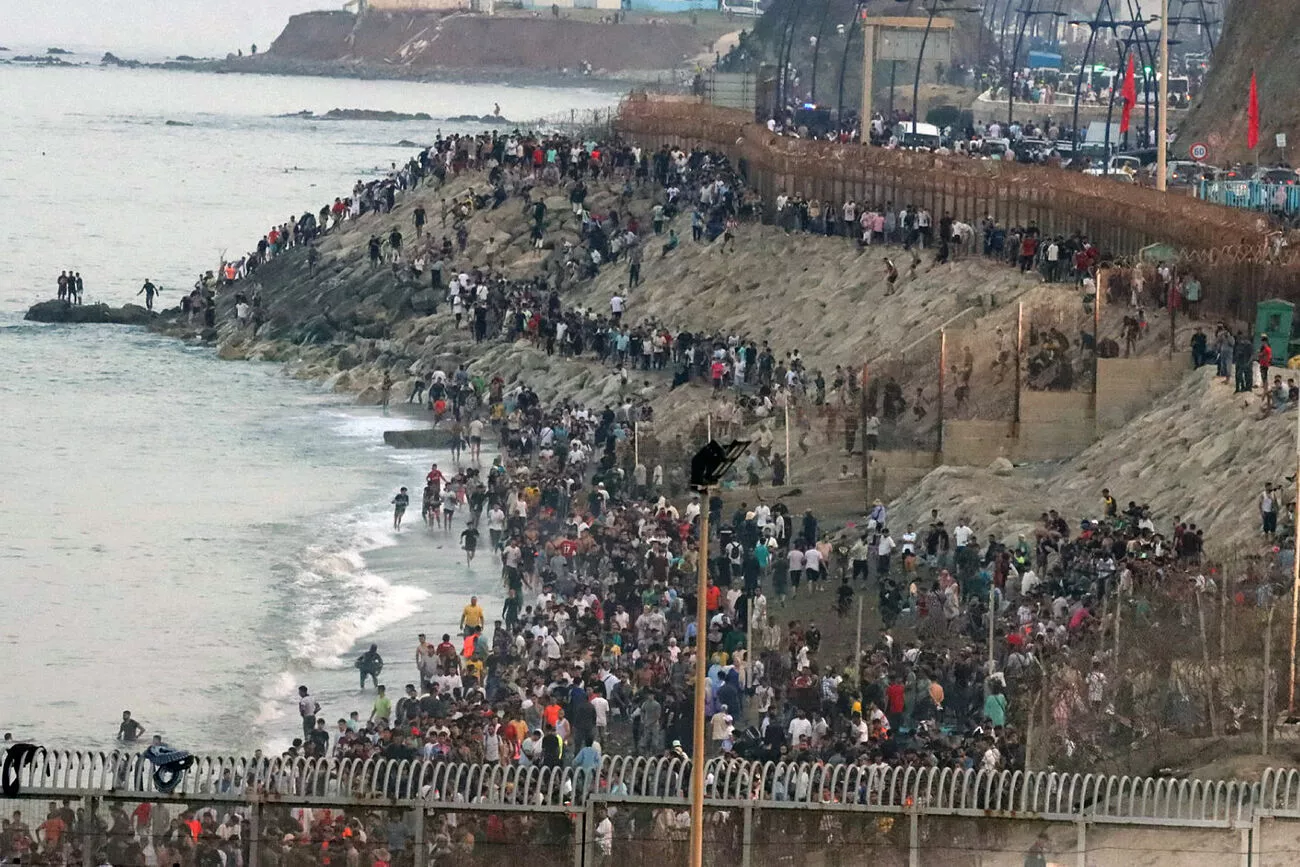
This update focuses on Ceuta migration crisis. At the end of July, an unprecedented rush towards Ceuta was quickly reframed online as an organised Moroccan “invasion”, powered by fake news and AI-generated images, with consequences that go far beyond the land border between Morocco and Spain.
Ceuta migration crisis: an exceptional but short-lived episode
On 30 and 31 July, Ceuta saw an exceptional influx of people crossing over from Morocco. According to figures released by the Spanish government, nearly 70,000 people entered the enclave in just two days.
This volume is unprecedented and highly concentrated in time. Spanish authorities described it as a migration crisis, linked to the summer season, curiosity about the enclave and expectations of shopping or job opportunities.
One month later, most of those who crossed have gone back to Morocco. On the ground, the Ceuta migration crisis has eased. But online, a very different story has taken hold.
From border reality to an “invasion” storyline
Very quickly, accounts on X, Facebook, TikTok and Instagram began framing the episode as a deliberate “invasion” organised by Morocco. Out-of-context videos, dramatic edits and AI-generated images went viral, often without any clear indication they were manipulated.
Some popular clips show artificially enlarged crowds, chaotic scenes that are not from Ceuta, or Moroccan flags added by AI onto archive images. These montages have been presented as proof of a coordinated plan to overwhelm the border.
In part of Spanish public opinion, the Ceuta migration crisis was then recast as a form of hybrid warfare, with Morocco allegedly using human pressure as a political weapon. This narrative has been echoed by some media outlets and politicians, despite the fact that most visitors returned home within days.
AI, social networks and media escalation
Artificial intelligence plays a central role in constructing this “invasion” narrative. Public and semi-professional tools now make it possible to generate realistic images and videos in minutes, often hard to distinguish from genuine footage at first glance.
Combined with recommendation algorithms that reward the most shocking content, these videos and images have been widely viewed, shared and commented on. The more alarming a clip looks, the higher it rises in feeds, pushing aside factual reporting or fact-checks.
Ceuta is not unique in this respect. But the episode highlights how vulnerable any migration event has become to disinformation, especially at a symbolic crossing point between Europe and Africa.
For Moroccans abroad: image of Morocco and confusing signals
For Moroccans living abroad, this gap between facts and narrative can have several consequences. First, it can feed suspicion in some host countries, where these videos circulate stripped of any context.
Families settled in Europe may face questions or even hostile remarks triggered by these exaggerated images of “invasion”. Morocco’s image, with the this case at its centre, risks being reduced to these sensational clips.
Second, these alarmist storylines can blur how mobility rules are understood. Many Moroccans abroad plan trips, border crossings or even long-term return projects based on what they see online.
- Confusion between tourists, cross-border workers and people in an irregular situation.
- Rumours about long-term border closures or generalised crackdowns.
- Overblown fears about checks during return journeys to Morocco or crossings through Spain.
To know the real situation on borders, visas and procedures, it remains essential to consult the official websites of Moroccan authorities and transit countries. The official portal of the ministry in charge of Moroccans living abroad is one of the key reference points.
Learning to spot fake news on migration
The Ceuta episode shows how crucial it is to develop simple reflexes when facing viral content on migration.
Check the date and source of the video. Look up whether reliable media have confirmed the images. Pay attention to visual details that often betray AI-generated content.
For Moroccans abroad, these reflexes have become essential to keep a clear picture of what is happening in Morocco and at its borders, without being dragged into carefully crafted “invasion” scenarios designed to provoke fear or serve political agendas.
The debate around the this issue will likely continue in Spain and in Morocco. But it now also depends, perhaps more than ever, on everyone’s ability to separate real events from digital fiction.
For more context, readers can follow Canal212 news for Moroccans abroad.
Don’t miss out on the latest news from the diaspora!
Sign up for our next newsletter to receive our practical guides, advice (on procedures and investment) and the latest news for French nationals living abroad, delivered straight to your inbox.