


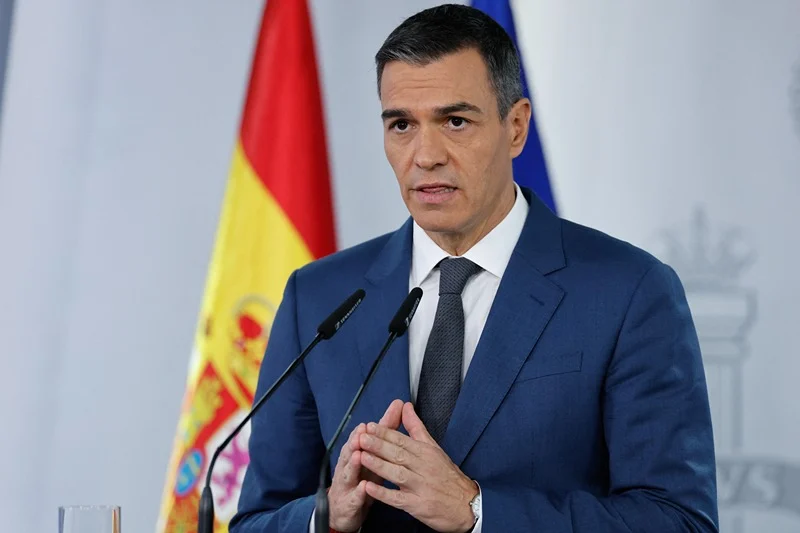
This update focuses on Pedro Sánchez Ceuta. Spain’s prime minister Pedro Sánchez has firmly ruled out any Moroccan involvement in the late July migration crisis in Ceuta, underlining Morocco’s key role in how both countries manage their shared border and people’s movements.
Pedro Sánchez Ceuta remarks clear Morocco of accusations
In a televised interview, Pedro Sánchez said there was no concrete evidence linking Morocco to the sudden movements of migrants towards Ceuta. By doing so, he distanced himself from narratives that had blamed Rabat in the aftermath of the mass arrivals.
Instead, the Spanish leader praised the mobilisation of Moroccan authorities. He described their reaction as an “intelligent” way of handling the influx, aiming to reduce risks for the people on the move in a context he considers very difficult on both sides of the border.
Sánchez rejected the description of Moroccan behaviour as “passive”. He insisted that the scale and speed of arrivals made the situation almost impossible to manage under the circumstances, for Spain as much as for Morocco.
Stronger cooperation on migration management
The Spanish prime minister also gave more detail on how this Ceuta crisis and wider migration flows are being handled. He said that around 200 Moroccans are returning home every day of their own accord, due to a lack of opportunities in Spain.
He added that, “by the end of the year”, the Spanish government expects that all migrants due to be expelled will have left the country, while those with a right to asylum will be allowed to stay. The message is a mix of firmness and respect for legal protections.
Pedro Sánchez further called for more reception capacity in the occupied city of Ceuta, to avoid overcrowding in future crises. He stressed the need to “reinforce cooperation with Morocco”, both at European level and in the bilateral relationship.
For Moroccans living abroad, these signals confirm a broader trend: migration and border management between Rabat and Madrid rely increasingly on political coordination. This affects controls at the border, regular mobility channels and the overall climate around crossings.
For Moroccans abroad: a political context that matters
Sánchez’s comments on Ceuta come as sections of the Spanish political class continue to talk about alleged Moroccan “blackmail”. The socialist leader replied firmly that he is “absolutely not” subject to such pressure from Rabat.
He criticised repeated accusations coming from the Popular Party (PP), the far-right Vox party and the president of the Basque Nationalist Party (PNV), Aitor Estéban. In his view, public debate should be based on facts, not rumours.
For Moroccans abroad who travel regularly between Europe and the Kingdom, a few points are worth keeping in mind:
- the land border between Morocco and Ceuta remains sensitive, but official cooperation is presented as solid;
- Spain is highlighting a more structured approach to deportations and asylum processing;
- the Spanish government now openly recognises Morocco’s active role in controlling migration flows.
These developments do not directly change consular or administrative procedures for Moroccans living abroad. However, they help consolidate a political framework that shapes travel conditions, how migrants are perceived and the broader climate around mobility between Morocco and Spain.
For official information on rights, returns and procedures, the website of the ministry in charge of Moroccans living abroad remains a key reference: https://www.mre.gov.ma/. Canal212’s practical guide on procedures for Moroccans abroad is also a useful tool to review current steps and best practices when travelling between Morocco and Europe.
For more context, readers can follow Canal212 news for Moroccans abroad.
Don’t miss out on the latest news from the diaspora!
Sign up for our next newsletter to receive our practical guides, advice (on procedures and investment) and the latest news for French nationals living abroad, delivered straight to your inbox.