


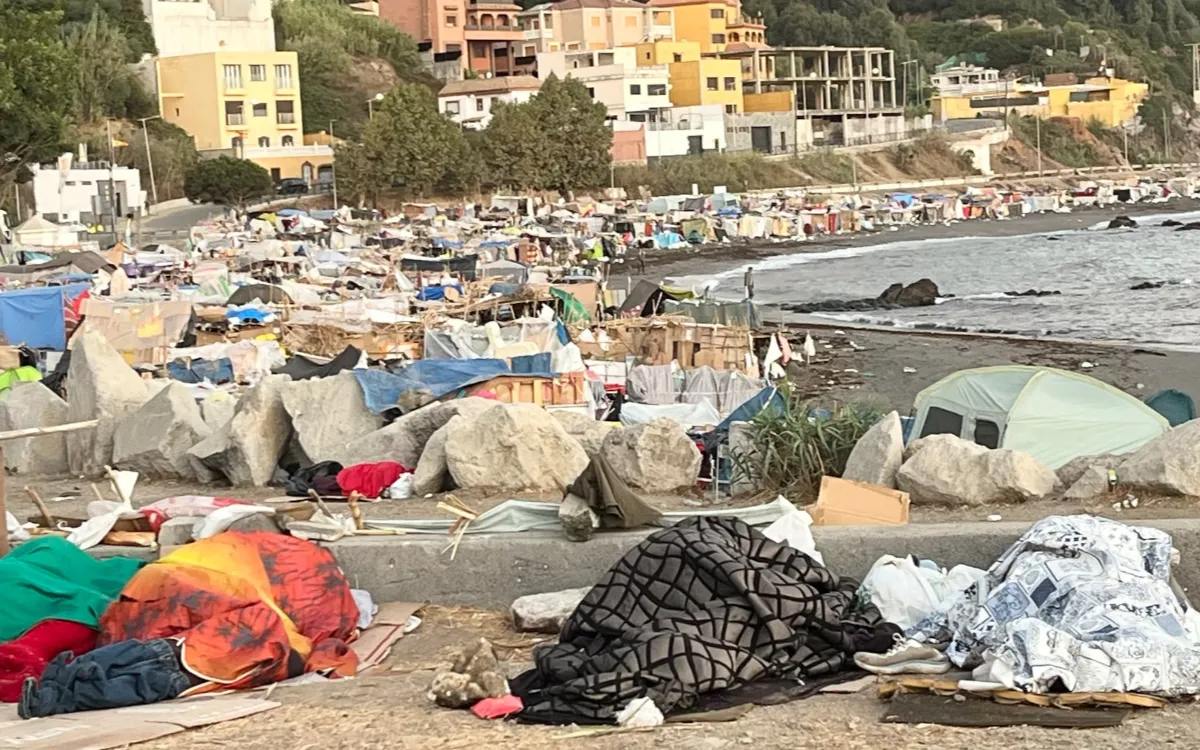
This update focuses on Ceuta CNI alert. A Spanish judge is trying to reconstruct what happened to an intelligence alert received the day before mass entries into Ceuta, a sensitive case that raises new questions over how Spain manages its border with Morocco.
A Ceuta CNI alert before the crossings
At the centre of the case is the Ceuta CNI alert from Spain’s National Intelligence Centre. On 29 July, intelligence officers flagged a call circulating on social media urging people to cross the border “over the fence and by sea” the following day at 8 p.m.
According to the investigation, two online groups with a combined audience of around 180,000 followers were identified in this alert. It specifically targeted the events of 30 and 31 July, when large numbers of people arrived from Morocco into the Spanish enclave.
For Moroccans living abroad who regularly transit through Ceuta, or follow developments along Morocco’s northern borders, the case shows how early warning did not prevent yet another migration crisis at the Morocco–Spain frontier.
Conflicting accounts inside the government delegation
The Ceuta CNI alert reached Gonzalo Sanz, then chief of staff to the Spanish government’s delegate in the enclave, Miguel Ángel Pérez Triano. Sanz says he immediately passed the message on to his superior.
The problem is that the delegate later stated publicly that he had not been informed by his aide. This contradiction is now at the heart of the probe led by judge María Tardón of Spain’s National Court.
Gonzalo Sanz left his post on 11 September and is due to testify as a witness on 1 October. He refused to appear by videoconference and insisted on being heard in person, underlining the importance he gives to his version of events.
His testimony could lead to the summoning of Miguel Ángel Pérez Triano, whose political and administrative responsibility in handling the alert is now under scrutiny.
Who knew what before 30 and 31 July?
The judge’s goal is clear: to determine which services were warned, who was supposed to act, and why the alert failed to prevent the mass arrivals from Morocco.
Beyond Sanz, the judge plans to hear the president of Ceuta, Juan Jesús Vivas, on 30 September, as well as Sebastián Vega, who headed the local police at the time. Their hearings should shed light on the decision-making chain and coordination between security forces.
For Moroccan families who use the Ceuta route during holidays or trips back home, the case does not, at this stage, change the usual conditions for regular border crossings. The probe mainly concerns the management of a large, public call to storm the border, and Spain’s capacity to respond.
Border security and travel: what could change?
In the short term, Spain has not announced any official changes to crossing procedures for Moroccan citizens or dual nationals at Ceuta. Checks for travellers with valid documents remain handled under the usual framework.
However, this case could push Madrid to review its alert protocols and preventive tools when mass crossings are being coordinated online. In practice, this might eventually mean:
- more visible deployments of security forces around the enclave in times of tension,
- better coordination between intelligence services and local authorities,
- closer monitoring of social media during sensitive periods.
For Moroccans abroad travelling by air or sea, irregular flows at Ceuta should not directly affect bookings with airlines such as Royal Air Maroc. It is still worth keeping an eye on the news whenever tensions rise along the northern border, and checking our practical resources, such as Canal212’s guide to key procedures for Moroccans abroad, to prepare trips with peace of mind.
The Spanish investigation is only beginning. It will determine whether the eve-of-crisis alert was handled with sufficient urgency and whether political responsibility will be assigned for the way this border episode was managed.
For more context, readers can follow Canal212 news for Moroccans abroad.
Don’t miss out on the latest news from the diaspora!
Sign up for our next newsletter to receive our practical guides, advice (on procedures and investment) and the latest news for French nationals living abroad, delivered straight to your inbox.