


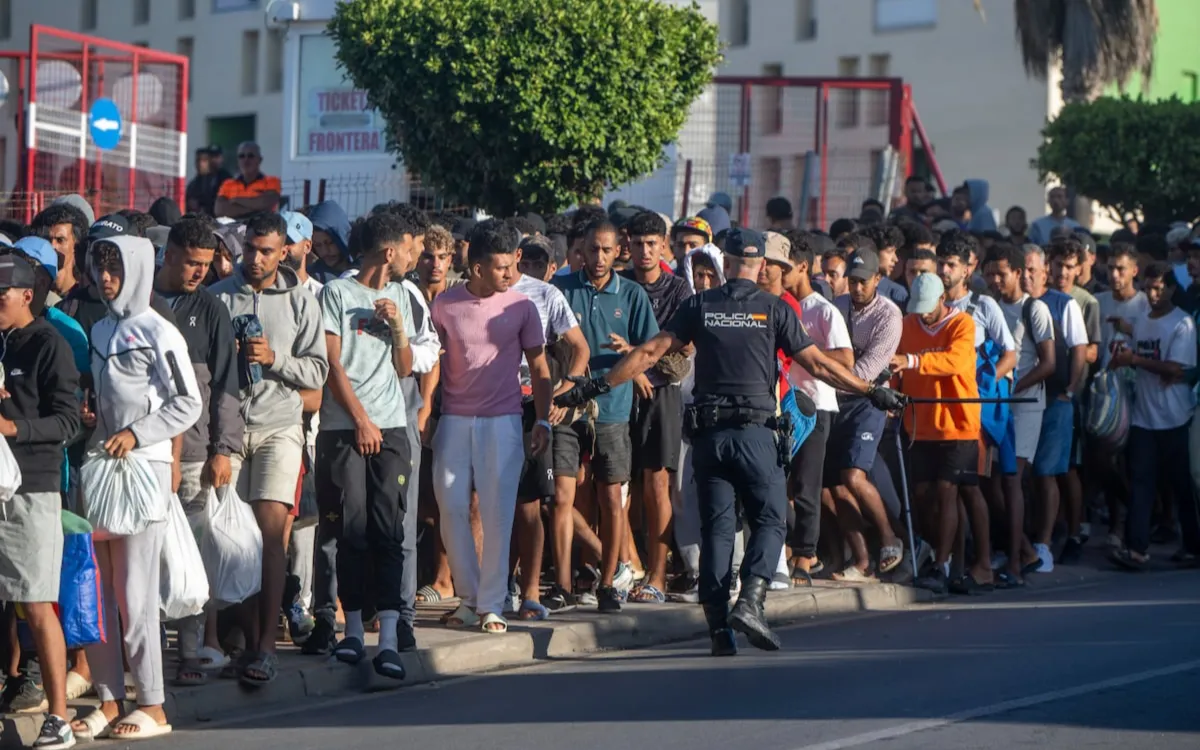
By describing Morocco’s border management as a “failure” after the Ceuta 72,000 crossings at the end of July, Pedro Sánchez has pushed the Morocco–Spain frontier back to the centre of political and security debates, with mobility between both shores at stake.
Ceuta 72,000 crossings: what to know
Speaking to CNN in New York, on the sidelines of the UN General Assembly, the Spanish Prime Minister openly acknowledged that the Moroccan security set-up around Ceuta did not hold.
“It is obvious that its border control has failed,” he said about Morocco, referring to the unprecedented influx recorded on 30 and 31 July.
According to figures reported by Spanish media, around 72,000 people are believed to have reached the enclave on foot or by swimming from Moroccan territory, in just a few hours.
Most of them are said to have returned quickly to Morocco, but several thousand migrants remained in Ceuta, overwhelming Spain’s reception capacity.
Deliberate opening or simple failure?
This new statement comes after weeks of shifting official language. Earlier reports had already suggested that Pedro Sánchez conceded that Morocco had “opened the floodgates” for around ten hours, without going so far as to call it a planned operation.
This time, he explicitly speaks of failure, while drawing a red line: the Prime Minister insists that there is still no solid evidence that Rabat designed or orchestrated the mass crossings.
Madrid says it is continuing its own investigation into the circumstances of the Ceuta 72,000 crossings and has formally asked Rabat for explanations and guarantees to prevent a similar situation from happening again.
Border, trust and Morocco–Spain mobility
For Moroccans who regularly travel between the Kingdom and Spain, this episode is a reminder that the border remains a highly political issue.
Several layers overlap:
- security cooperation between the two states, crucial for managing migration flows;
- smooth legal crossings, especially for families and seasonal workers;
- trust between Rabat and Madrid, which underpins the stability of sea links and flights.
Whenever tensions flare up around Ceuta or Melilla, the first concrete impact often shows up in longer queues, tighter checks and, at times, changing attitudes towards travellers of Moroccan origin.
What this could mean for return plans and travel
For now, the controversy over the Ceuta 72,000 crossings and Pedro Sánchez’s criticism has not led to announcements of closures or new restrictions directly targeting regular mobility.
Yet the episode highlights how fragile the political balance around the border can be. For those planning a permanent return, new investments or frequent round trips, it is wise to:
- monitor developments in Morocco–Spain relations through official channels;
- double-check entry requirements for Spain and Morocco before travelling;
- allow for extra time at borders during diplomatic tensions.
Both governments say they want to preserve a “positive” and “essential” partnership. The Spanish side stresses that it needs to keep working closely with Morocco, despite current criticism, to secure the frontier and manage migration flows.
How Rabat responds to Madrid’s request for explanations, and how the Spanish inquiry is handled, will shape the climate of trust over the coming months, and therefore, indirectly, the conditions of mobility between both shores.
For up-to-date information on consular procedures and paperwork, Moroccans living abroad can consult the official portal dedicated to them and refer, when available, to our own practical guide to key procedures.
For more context, readers can follow Canal212 news for Moroccans abroad.
Don’t miss out on the latest news from the diaspora!
Sign up for our next newsletter to receive our practical guides, advice (on procedures and investment) and the latest news for French nationals living abroad, delivered straight to your inbox.