


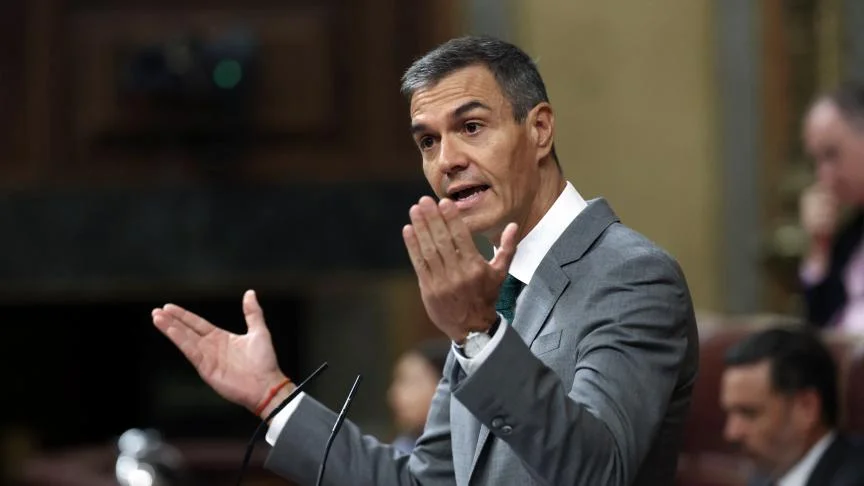
This update focuses on Sánchez declines to accuse Morocco. Speaking before the Spanish Parliament, Prime Minister Pedro Sánchez said his government currently has no evidence that Morocco planned the mass arrival of migrants in Ceuta at the end of July.
Sánchez declines to accuse Morocco without clear evidence
The Spanish leader explained on Thursday that Madrid has, at this stage, “no proof” that the influx was orchestrated by the Moroccan authorities.
“My responsibility is to handle this crisis with rigour and prudence, based on evidence and not on suspicions or partisan interests,” he said, according to Spanish media reports.
Pedro Sánchez stressed that “no one has presented the government with proof that the mass entry into Ceuta was designed or carried out by Morocco”.
He added that none of the competent Spanish institutions, nor the European Commission or any international body, has so far provided “solid evidence” directly implicating Rabat.
Warning to Rabat and summons of Karima Benyaich
While underlining the current lack of concrete elements, Pedro Sánchez also issued a political warning. “If solid evidence of this nature exists, we will act accordingly, with all the firmness the situation requires,” he said.
The socialist prime minister confirmed that a formal diplomatic step had already been taken. Spain’s Ministry of Foreign Affairs summoned Morocco’s ambassador in Madrid, Karima Benyaich, on 21 August.
The summons is meant to seek official explanations after the mass arrivals in Ceuta and to reiterate the importance of bilateral cooperation on border management.
For Moroccans living in Europe, especially those who regularly travel through Spain to visit family back home, these signals are worth watching. They can eventually influence the political climate around land and sea borders.
Ceuta crisis timeline and what it means for travellers
Pedro Sánchez outlined the Ceuta events to MPs in three phases. In the days before 30 July, the border situation was, according to him, “normal”, with no major incidents reported.
The second phase corresponds to the “mass influx” of migrants into the Spanish enclave, with sizeable groups crossing or attempting to cross the border and suddenly increasing pressure on security forces.
The third stage began in the following days and weeks. The prime minister said Moroccan security forces then tightened controls, especially around 15 August, by:
- carrying out hundreds of arrests
- blocking new attempts to leave for Ceuta
- visibly increasing their presence in the border zone
For Moroccans abroad, this episode is a reminder that migration and border control remain central issues in Morocco–Spain relations. They can, at times, affect:
- how smoothly land crossings to Ceuta and Melilla operate
- the general atmosphere around checks for overland travel
- the tone of Spain’s domestic debate on Morocco’s role
At this point, no concrete change has been announced regarding travel conditions or entry rules for Moroccan passport holders or Europeans of Moroccan origin. Still, those planning trips through Spain should monitor official developments, including government statements and consular updates.
In this tense yet still contained context, the line adopted by Pedro Sánchez – that “Sánchez declines to accuse Morocco” without proof – aims to preserve a minimum of diplomatic room for manoeuvre with Rabat, while keeping the option of a tougher response if future evidence points in another direction.
Information on this case may still be clarified or updated by official communiqués in both Morocco and Spain. Moroccans around the world can also check the latest advice from their consulates and practical resources, such as Canal212’s guide to key procedures for Moroccans abroad, to better plan travel and return projects.
For more context, readers can follow Canal212 news for Moroccans abroad.
For official updates, readers can check the relevant official source.
Don’t miss out on the latest news from the diaspora!
Sign up for our next newsletter to receive our practical guides, advice (on procedures and investment) and the latest news for French nationals living abroad, delivered straight to your inbox.