


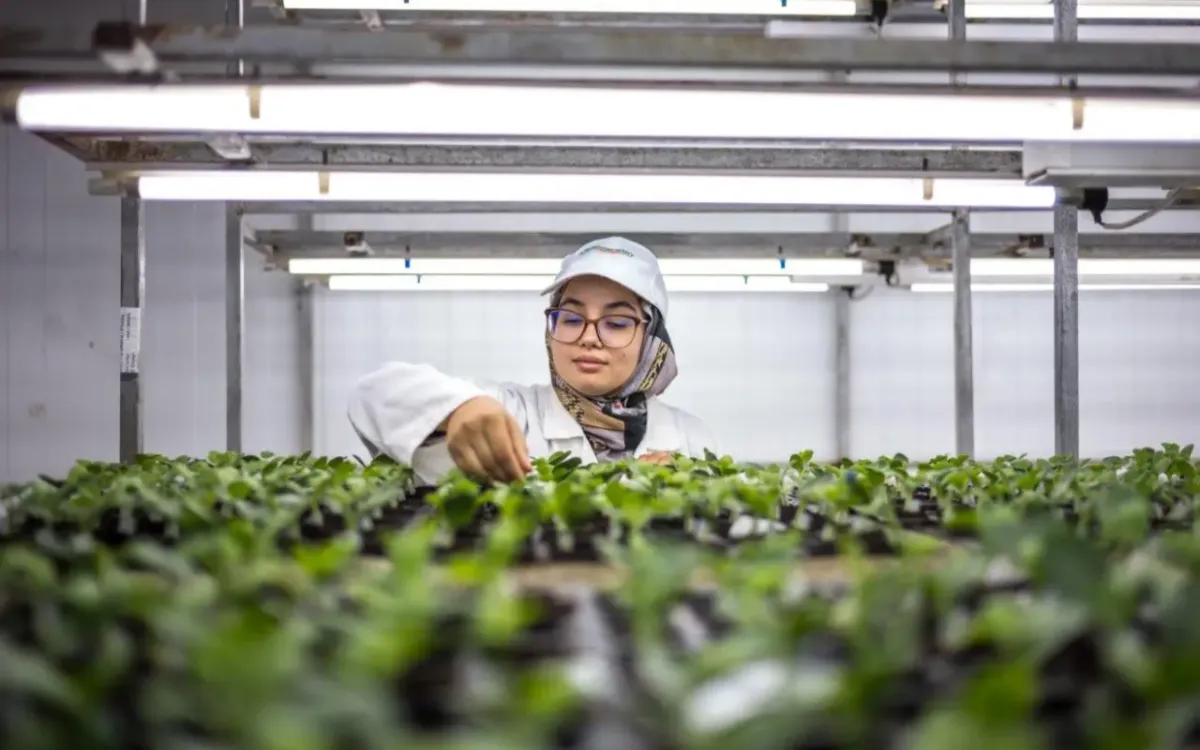
Azura is lifting the curtain on how it produces vegetables in Morocco. In a report published in the Netherlands, the professional outlet GroentenNieuws.nl focused on the group’s activities in the Agadir region. The area presented includes 24 farms and 600 hectares of crops, of which 500 hectares are dedicated to tomatoes.
The report also details how the group is organised. Production, packing, logistics and sales are coordinated between Morocco and France.
Azura: 24 farms around Agadir
The report, published on 2 September by GroentenNieuws.nl, presents Azura’s farming operations in the Agadir region.
The area visited brings together 24 agricultural holdings covering around 600 hectares of crops.
Tomatoes are at the heart of this production. They account for 500 hectares out of the 600 hectares highlighted in the report.
This set-up allows the group to concentrate a significant share of its output in a single agricultural region.
500 hectares dedicated to tomatoes
Tomatoes are one of Azura’s main crops in Morocco.
On the farms presented around Agadir, they represent more than 80% of the cultivated area. The group works on several varieties in particular for European markets.
Agadir’s proximity to major logistics infrastructure then makes it easier to ship products to their destination markets.
This location is part of an integrated model, with Azura controlling several stages between farm production and retail sales.
From Moroccan fields to the Perpignan hub
After being grown in Morocco, the vegetables are routed to Azura’s commercial and logistics platform in Perpignan, in the south of France.
This hub plays a key role in the group’s European distribution.
The products are marketed in France, Italy, Spain, Portugal and Switzerland, among other countries.
This set-up allows Azura to bring its Moroccan agricultural production closer to its main European markets.
France remains Azura’s leading market
Pierre Boniol, Azura’s chief executive officer, also commented on how the group’s markets are evolving in his interview with GroentenNieuws.nl.
France remains the group’s largest outlet, although its share of total sales has fallen compared with previous years.
This trend reflects the gradual diversification of Azura’s European markets.
The group is seeking to expand its customer base beyond France. Italy, Spain, Portugal and Switzerland are among the markets it currently serves.
An integrated model between Morocco and Europe
The organisational model described by the Dutch outlet illustrates how Azura operates internationally.
Morocco hosts a major part of the production system, while France is mainly responsible for commercial and logistics activities.
This complementarity enables the group to link its farms directly to European supermarket shelves.
The model is built on a chain that combines production, packing, transport and distribution.
Agadir at the heart of agricultural production
The Agadir region plays a strategic role in this set-up.
The area has a strong agricultural sector serving both Moroccan and international markets, with greenhouse crops in particular occupying a major share.
With its 24 farms and hundreds of hectares of crops, Azura is one of the key players in this value chain.
The GroentenNieuws.nl report sheds light on an agricultural infrastructure that is largely invisible to the general public, yet directly connected to European supermarket aisles.
Azura continues to diversify across Europe
The relative decline in France’s share of total sales also highlights how the group is changing.
Azura now serves several European markets. This diversification reduces its dependence on a single country and broadens its commercial opportunities.
To support this strategy, the group relies on a transnational organisation. The crops grown around Agadir feed into a distribution network that spans multiple European countries.
Azura is thus confirming Morocco’s central role in its farming operations, with the Agadir region as one of its main production hubs.
External sources:
Don’t miss out on the latest news from the diaspora!
Sign up for our next newsletter to receive our practical guides, advice (on procedures and investment) and the latest news for French nationals living abroad, delivered straight to your inbox.