


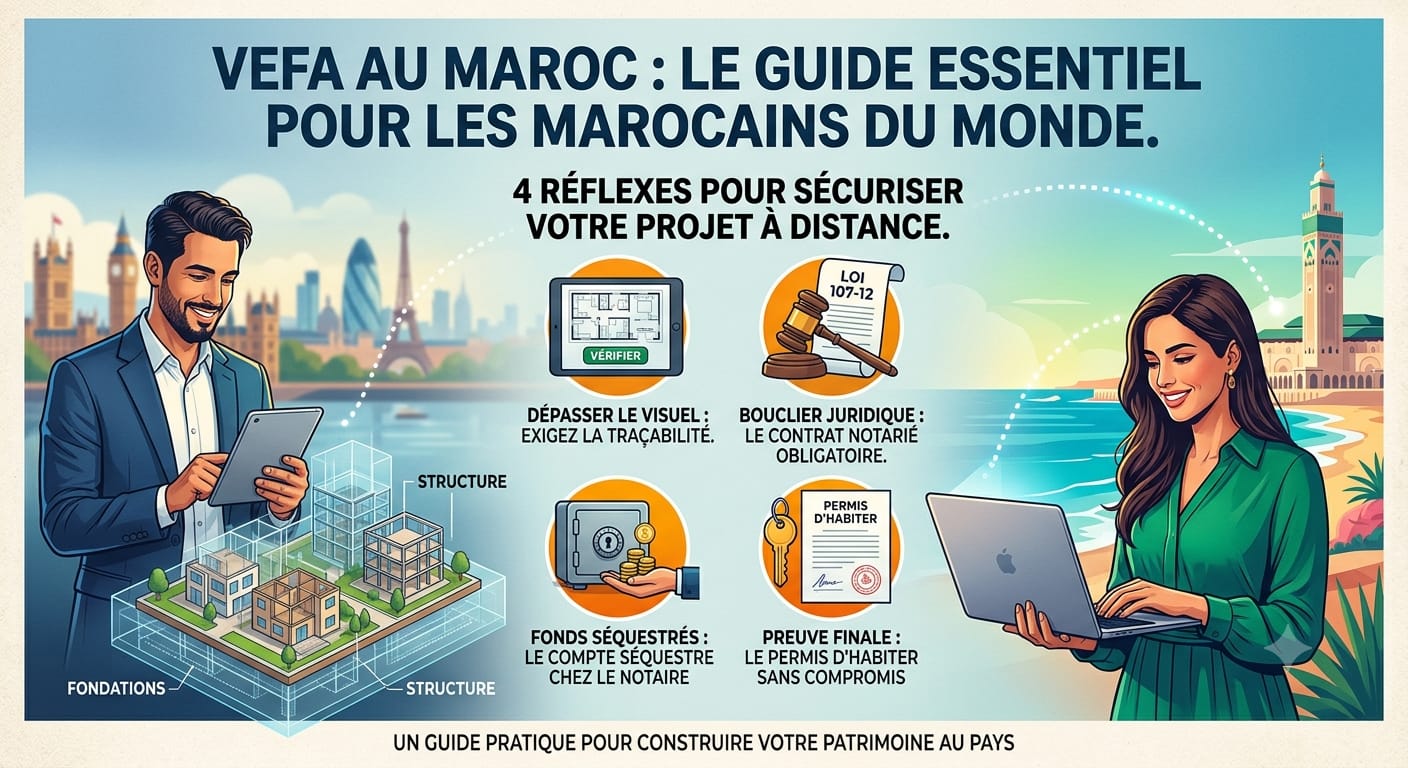
Buying off-plan property in Morocco from abroad through a VEFA contract allows Moroccans living overseas and international investors to build real estate assets in the Kingdom. However, distance makes extra vigilance essential.
Construction delays, compliance of the property, payment schedule and administrative paperwork: several stages require close attention. Vente en l’État Futur d’Achèvement (VEFA), or sale of property in future state of completion, provides a specific legal framework for buying off-plan in Morocco.
Law no. 107-12, which amended and completed the system introduced by law no. 44-00, sets out in particular the different contracts, payment milestones, guarantees and the conditions required to sign the final deed of sale.
Why VEFA in Morocco appeals to Moroccan expatriate investors
Buying off-plan has several advantages for someone living abroad. It makes it possible to secure a unit in a real estate project before completion and to spread payments over time according to the construction milestones set out in the contract.
But investing from another country also raises very practical questions.
How can you check the progress of the works? How can you be sure the developer is honouring their commitments? Which documents must be checked before transferring substantial amounts?
The first step is to understand the legal framework governing VEFA in Morocco when you are buying from abroad.
A legal framework for buying off-plan in Morocco
The Moroccan VEFA regime is based in particular on articles 618-1 et seq. of the Code of Obligations and Contracts, as amended by law no. 107-12.
This framework regulates the main stages of an off-plan transaction. It provides for a reservation contract, then a preliminary contract, and finally a definitive contract once the legal conditions have been met.
Using a qualified legal professional to draft and register the deeds is also a cornerstone of the system.
For a buyer living outside Morocco, this step helps to secure the transaction from a legal standpoint and to verify all documents related to the property.
Payments are strictly regulated by law
One of the main issues with buying off-plan lies in the amounts paid before the property is completed.
The legislation provides for guarantees designed to protect the deposits and instalments paid by the buyer. In particular, the contract drafter may only release payments to the seller once the guarantee required by law has been put in place.
The payment schedule must also follow the progress of the building works and the conditions laid down in the contract.
The buyer must therefore check very carefully when each instalment becomes due and under which conditions it can be demanded.
Completion guarantees limit certain risks
The legal framework also provides for a specific guarantee to cover sums paid by the buyer in situations defined by law.
This completion guarantee is a key element of the file. It is designed in particular to protect the buyer if the seller is no longer able to carry the project through under normal conditions.
It is therefore important to ask the professional in charge of the transaction for documents proving the existence and conditions of this guarantee before continuing to make payments.
Pre-notation: an additional layer of protection
The law also provides for a pre-notation mechanism when certain conditions are met.
For a registered property, the buyer may ask the Land Registry (Conservation foncière) to record a pre-notation on the basis of the preliminary contract when the total advances exceed 50% of the sale price.
This entry temporarily preserves the buyer’s rights until the final contract is registered.
For an investor living abroad, this mechanism deserves special attention as part of the legal monitoring of the file.
The occupancy permit marks a decisive milestone
The end of construction works alone is not enough for the property to be considered legally completed.
Article 618-15 provides that the building is deemed completed once the occupancy permit or the certificate of conformity has been obtained.
The final contract is then signed under the conditions laid down by law.
The seller must in particular provide the contract drafter with a certificate from the architect confirming that the works are completed and comply with the specifications. The occupancy permit or certificate of conformity, as well as separate title deeds where required, are also among the conditions for establishing the final deed.
Buying remotely with a power of attorney
Living abroad does not necessarily mean you have to carry out every single formality in person in Morocco.
Depending on the situation and applicable procedures, the buyer can delegate certain steps to a representative, in compliance with the legal formalities required for the power of attorney.
However, the power of attorney must be drafted carefully. It should clearly state the powers granted and be drawn up in line with the formal requirements applicable to the case.
The notary or legal professional in charge of the deed can assist the buyer with this process.
Key documents to check before committing to a VEFA
Before signing a VEFA contract in Morocco, an investor residing abroad should check a number of elements:
- the land title of the plot or building;
- the legal status of the property;
- the necessary administrative authorisations;
- the reservation contract, where applicable;
- the preliminary contract;
- the detailed payment schedule;
- the guarantees required by law;
- documents relating to the progress of the works;
- delivery conditions;
- documents required for the final deed of sale.
A legal professional can also check for any mortgages, charges or other entries that may affect the property.
VEFA offers protection, but not zero risk
Buying off-plan in Morocco now benefits from a clear and detailed legal framework. However, no real estate transaction can be considered entirely risk-free.
Protection depends in particular on compliance with legal obligations, the quality of the contractual documents, the developer’s situation and the day-to-day monitoring of the project.
For a Moroccan expatriate (MRE) investor, distance makes independent legal advice even more crucial.
VEFA can be an attractive way to invest in Moroccan property from abroad. But the safety of the project ultimately depends on careful document checks, strict compliance with the legal steps and professional follow-up of the file.
External sources:
Don’t miss out on the latest news from the diaspora!
Sign up for our next newsletter to receive our practical guides, advice (on procedures and investment) and the latest news for French nationals living abroad, delivered straight to your inbox.