


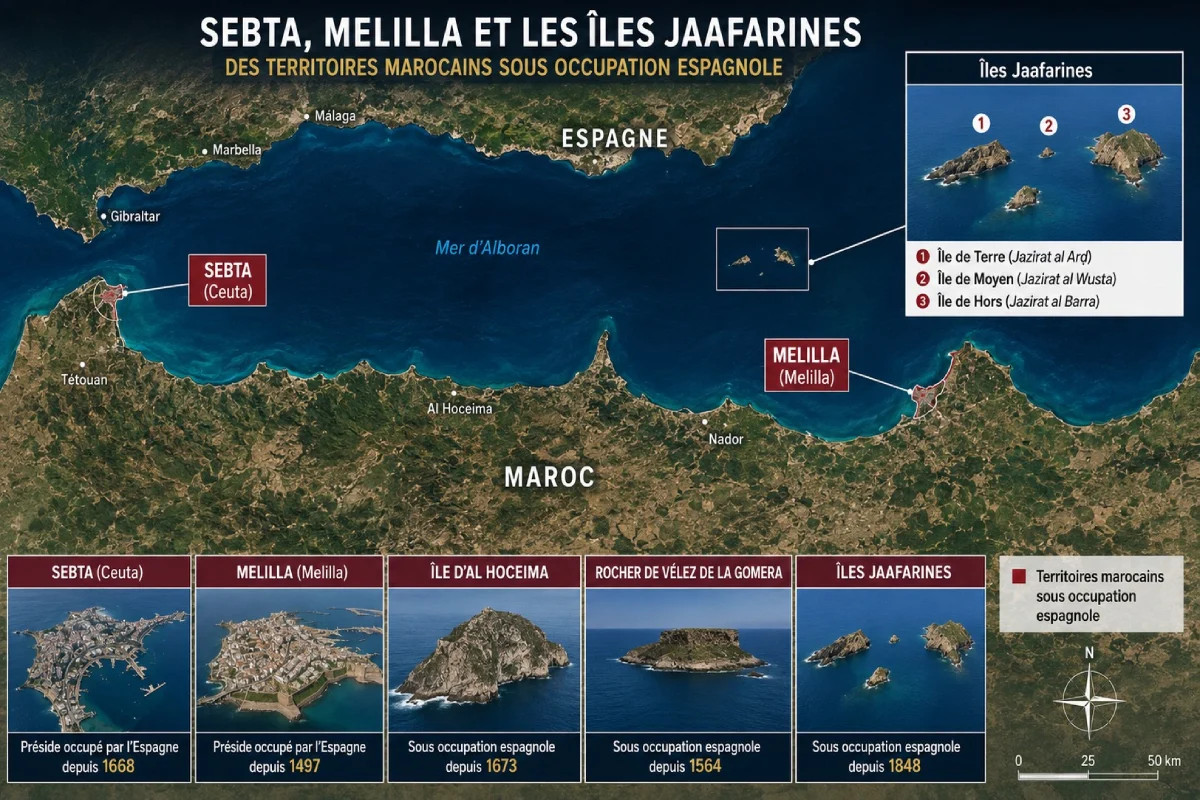
At a time when tensions and negotiations between Rabat and Madrid regularly bring Sebta, Melilla and nearby islands back into the spotlight, a Morocco Sebta Melilla document from 2009 has resurfaced, restating in black and white the Kingdom’s official position on these Spanish-held territories.
Morocco Sebta Melilla document: what to know
The document was published in Morocco’s Official Bulletin No. 5714, dated 5 March 2009. It accompanies the publication of the United Nations Convention on the Law of the Sea, signed in Montego Bay, as well as the agreement on the implementation of Part XI.
This text, included in Dahir No. 1.04.134 of 23 May 2008, contains an explicit declaration by the Moroccan government. It states that “Sebta and Melilla, the island of Al Hoceima, the rock of Vélez de la Gomera and the Jaafarine Islands are Moroccan territories”.
The same declaration adds that Morocco “has never ceased to claim the recovery of these presidios under Spanish occupation in order to complete its territorial integrity”. The dahir was countersigned at the time by former head of government Abbas El Fassi.
What this means for Moroccans living abroad
For Moroccans living abroad, this Morocco Sebta Melilla document does not change practical day-to-day procedures. Visa regimes, border checks and travel rules between Morocco, Sebta, Melilla and the Schengen area remain the same.
Its main impact is political and symbolic. It shows that the stance defended today in public debates is not new, but rooted in an official text published more than a decade ago.
For Moroccans in Europe and especially in Spain, this legal basis helps explain why the issue of the presidios regularly returns to the bilateral agenda between the two countries.
In the medium and long term, this reminder could influence:
- future talks on maritime boundaries and exclusive economic zones off northern Morocco;
- negotiations on joint border management and mobility frameworks;
- how Moroccan authorities defend their positions in international bodies.
Law of the Sea accepted with clear Moroccan reservations
The significance of the text goes beyond the affirmation of the Moroccan nature of Sebta, Melilla and the nearby islands. The dahir also clarifies how Morocco accepts the UN Convention on the Law of the Sea.
The government states that ratification of the convention “can in no way be interpreted as recognition of this occupation”. In other words, Morocco accepts the international rules at sea, but not at the expense of its territorial claims.
The Kingdom also formulates several reservations regarding the interpretation and application of the convention. It indicates that it does not consider itself bound by national laws or declarations of other states that would run counter to its rights.
The declaration refers to the provisions of the convention on dispute settlement, particularly Articles 287 and 298. Morocco reserves the right to invoke these mechanisms “at the appropriate time”.
No immediate impact on travel and projects, but a long-term marker
This Morocco Sebta Melilla document is not a new diplomatic move, but it confirms that the issue is firmly embedded in the Moroccan state’s doctrine.
For Moroccans abroad who are planning visits, investment or a future return home, there is no immediate change to travel or residency procedures. The current legal framework governing entry into Morocco and the Schengen area remains in place.
However, this reminder is a useful marker for the future. It underlines that any evolution in relations between Rabat and Madrid will continue to be shaped by this long-standing position on Sebta, Melilla and the presidios.
For more context, readers can follow Canal212 news for Moroccans abroad.
For official updates, readers can check the relevant official source.
Don’t miss out on the latest news from the diaspora!
Sign up for our next newsletter to receive our practical guides, advice (on procedures and investment) and the latest news for French nationals living abroad, delivered straight to your inbox.