

This update focuses on Morocco EU health reforms. The PASS III health support program, jointly led by Morocco and the European Union since 2020, has officially come to an end in Rabat, closing a key chapter in external support to Morocco’s health reforms.
Morocco EU health reforms born in the Covid-19 crisis
Launched in 2020 at the height of the pandemic, PASS III was part of the broader strategic partnership between Morocco and the European Union. Its aim was to back Morocco EU health reforms at a time when the country was under strong pressure from Covid-19.
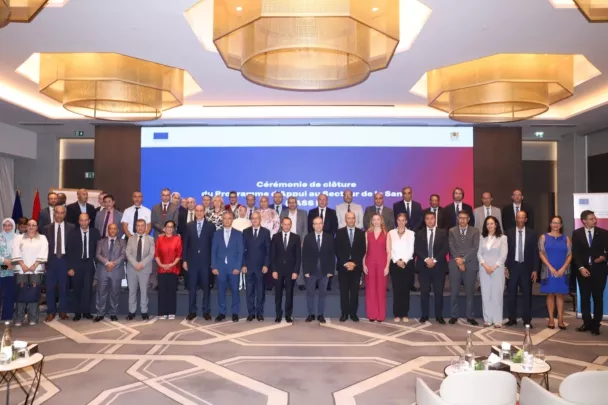
The closing ceremony took place on Wednesday in Rabat, chaired by Minister of Health and Social Protection Amine Tehraoui and EU Ambassador to Morocco Dimiter Tzantchev. Officials used the event to present the program’s results and recall its main contributions to the public health system.
Quality of care, governance and crisis preparedness
According to Moroccan and EU representatives, PASS III has contributed to several structuring projects in the health sector. The program focused in particular on:
- improving the quality and safety of care;
- strengthening territorial health governance;
- enhancing preparedness and response to health crises.
Minister Amine Tehraoui praised the partnership with the European Union in the health field. He underlined that the achievements supported by PASS III are helping Morocco build a fairer, more efficient and more resilient system, with services closer to citizens.
For Moroccans living abroad who return home for treatment or medical check-ups, these Morocco EU health reforms affect very concrete aspects of daily life: how public hospitals are organised, the quality of reception, and the system’s capacity to cope with new emergencies.
A forward-looking partnership on public services
Beyond the technical end of PASS III, the Rabat meeting also served to confirm that Morocco and the European Union intend to keep working together in a forward-looking strategic partnership.
Both sides highlighted cooperation based on complementarity and on a shared ambition to consolidate a more resilient health system serving all citizens. For the Moroccan community abroad, this direction is consistent with the broader reforms underway in Morocco, including the expansion of social protection and the modernisation of public services.
While no detailed roadmap has yet been presented for the next steps, officials stressed that EU support to Morocco’s major social reforms will continue. The momentum created by PASS III should therefore carry on under new instruments aligned with the country’s health transformation and the lessons learned from the pandemic.
One piece of Morocco’s wider social reform agenda
PASS III was only one element within a much wider overhaul of the Moroccan health system. Signed in 2020, the program complemented other reforms already underway, such as the roll-out of mandatory health insurance, the strengthening of regional facilities and the push to improve access to care across the country.
For Moroccans abroad considering a temporary or permanent return, the evolution of the health system remains a key factor in quality of life. The end of PASS III does not mean that change is over; rather, it marks the close of one structured phase of this case.
In the coming months, it will become clearer how this partnership will evolve, and which new initiatives might further improve access and quality of care for residents in Morocco as well as visiting members of the diaspora.
For more context, readers can follow Canal212 news for Moroccans abroad.
For official updates, readers can check the relevant official source.
Don’t miss out on the latest news from the diaspora!
Sign up for our next newsletter to receive our practical guides, advice (on procedures and investment) and the latest news for French nationals living abroad, delivered straight to your inbox.