

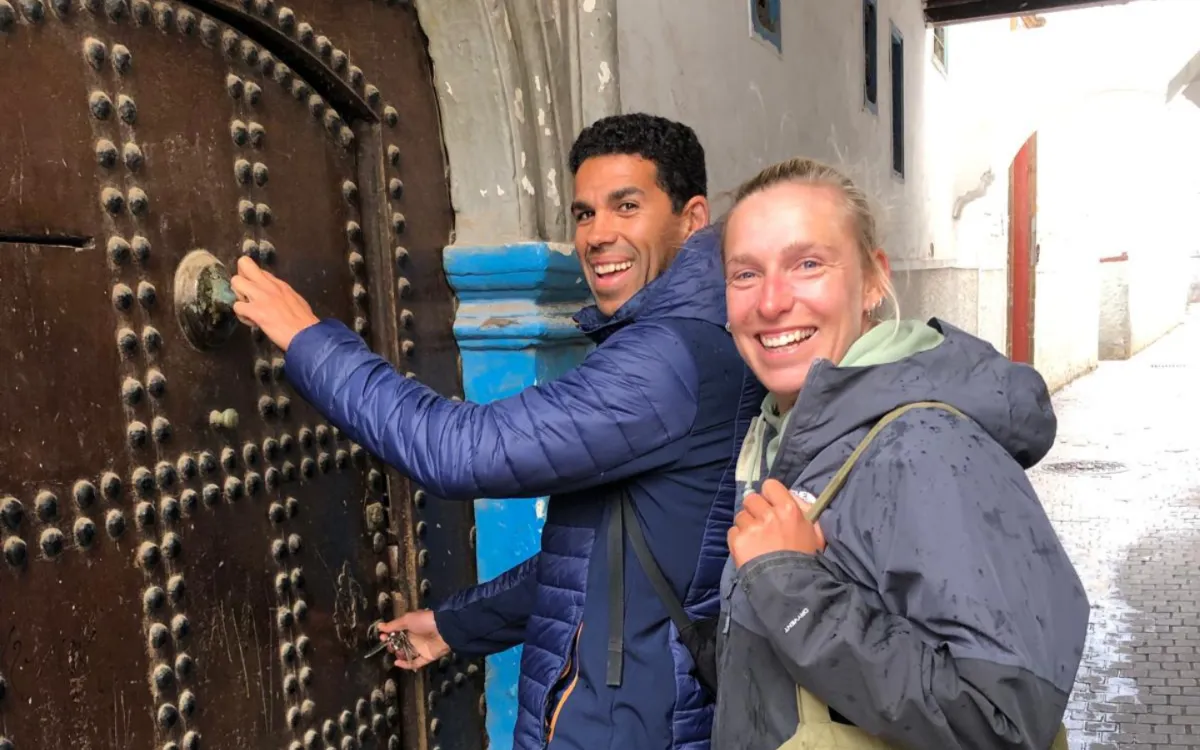
In 2015, a Dutch traveller came to learn surfing in Rabat and fell in love with her Moroccan instructor. Eleven years later, the couple has turned a Rabat abandoned riad into a small family-run surf hotel, offering a different way to build a life between Morocco and Europe.
A chance meeting on Rabat’s waves
The story begins in 2015, when Nina Ottevanger visits Morocco with two friends. In Rabat, they decide to book a surf lesson. The scheduled group has already left, but instructor Ilyass Gougali offers them a private session.
That day marks the start of a long-distance relationship between the Dutch student and the Moroccan surfer. Nina returns regularly to Rabat during her university holidays, and the bond grows stronger visit after visit.
In 2016, Ilyass goes on to manage a surf camp on the Atlantic coast, while Nina secures an internship at a nearby tourism business. This first shared professional experience in Morocco confirms their desire to work together in the sector.
Living between Morocco and the Netherlands
After graduating in tourism, Nina gets a job at a travel agency in The Hague. Ilyass later joins her in the Netherlands and the couple marries in 2021.
Life in northern Europe proves challenging for Ilyass, who struggles with the Dutch winters. The couple opts for a hybrid lifestyle: working in the Netherlands during summer and spending winters in Morocco.
They launch a surf school in Rabat and arrange homestays for their clients in the medina. For three years, they split their time between the two countries. Many Moroccans living abroad know this feeling well: constant travel, suitcases always packed, and difficulty planning long term.
“It was difficult to build a life when we were only staying half of the year in the same place,” Nina explains in a testimony quoted on 21 September by Business Insider.
A Rabat abandoned riad turned into a life project
In 2024, the couple decides to stabilise their lives by clearly choosing Morocco as their base. They start searching for a Rabat abandoned riad in the part of the medina closest to the ocean, to make it easy for future guests to walk to the beach with their surfboards.
They eventually find a very run-down traditional house that has stood empty for more than twenty years. The building needs major renovation work before it can host guests.
No figures have been shared about the renovation budget or the future capacity of the guesthouse. But the idea is clear: a small, family-scale hotel focused on surfing and welcoming travellers who want an authentic Moroccan experience.
What this story means for Moroccans abroad
For Moroccans settled in Europe and considering a return, this journey highlights a strong trend: turning an old house or empty property into a tourism or hospitality project.
Such ventures, however, come with constraints:
- they require time on the ground in Morocco to follow the works;
- they demand a good understanding of the medina, ownership rules and permits;
- they involve careful planning for hospitality (legal status, taxation, safety rules).
To move forward with similar projects, Moroccans living abroad can reach out to consulates, local administrations in Morocco or dedicated investment desks. The official portal for Moroccans abroad brings together key institutional links for preparing a return, an investment or a hospitality business.
Ultimately, Nina and Ilyass’s experience shows how a simple surf lesson can lead to much more than a holiday memory: a long-term anchor in Morocco, a shared business, and for many binational or mixed couples, a concrete way to bridge two shores.
For practical steps and procedures, you can also consult Canal212’s guide to essential procedures for Moroccans abroad, updated on a regular basis.
For more context, readers can follow Canal212 news for Moroccans abroad.
Don’t miss out on the latest news from the diaspora!
Sign up for our next newsletter to receive our practical guides, advice (on procedures and investment) and the latest news for French nationals living abroad, delivered straight to your inbox.