


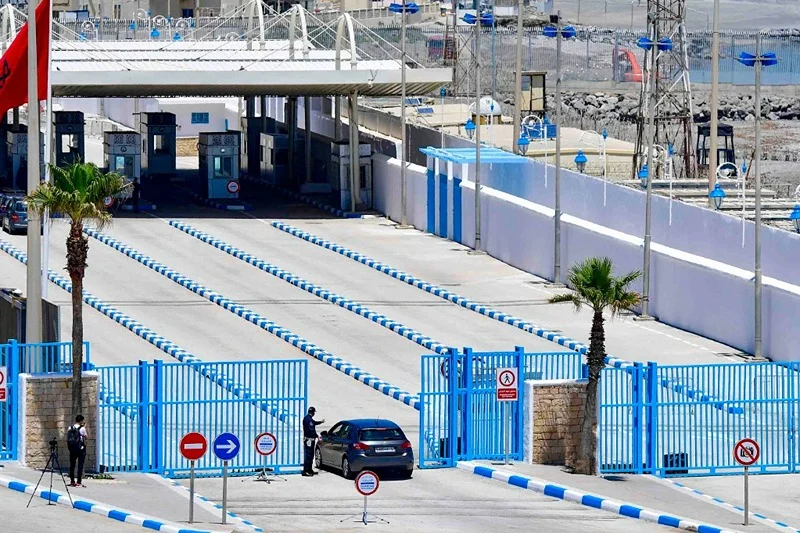
An early-morning incident at the Bab Sebta border crossing has led Moroccan and Spanish authorities to tighten security, with possible consequences for many travelers, including Moroccans living abroad returning home by road.
Bab Sebta border breached by a speeding car
According to Spanish security sources, the incident occurred around 6:30 a.m. on Monday. A Renault 19 car sped through the Moroccan control installations and then crossed the checkpoints of the Spanish Civil Guard and National Police.
The vehicle managed to enter the occupied enclave of Ceuta without being stopped at the time. It was later found abandoned on a downtown street, while the driver fled and remained at large when the first reports emerged.
Investigators have not ruled out that other people may have been in the car when it broke through the Bab Sebta border controls. All scenarios remain open, although an attempted illegal entry is considered a likely motive.
Tighter checks and potential delays for road travelers
In response, a reinforced security deployment has been put in place at the crossing. On the Spanish side, police are carrying out detailed technical and forensic checks on the seized vehicle to reconstruct the route of the intrusion and verify any possible cargo.
In practical terms, travelers using the Bab Sebta border to enter or leave Morocco should expect:
- more thorough checks of vehicles and luggage;
- longer queues at both Moroccan and Spanish posts;
- extended crossing times, especially in the early morning;
- heightened scrutiny of profiles considered risky by the authorities.
This comes in a sensitive context, just two months after large-scale attempts to cross the border were recorded at the end of July. Security services are keen to prevent any new breach.
What Moroccans living abroad should plan for
For Moroccans abroad who transit through Ceuta on their way to or from Morocco, this incident does not mean the border is closed, but it can make the journey more complicated.
In practice, it is advisable to:
- allow extra time in your schedule for crossing the border;
- avoid peak hours whenever possible;
- keep travel and vehicle documents ready at hand to speed up checks;
- monitor any guidance or updates issued by the authorities on both sides.
For those hesitating between driving and flying, it may be useful to compare total travel time and constraints. Transport operators and airlines regularly publish updates on their official websites, as does Royal Air Maroc for air traffic affecting flights to and from Morocco.
In the coming days, it will become clearer whether stricter controls at the this case will remain in place or be eased once the investigation progresses. Until then, travelers are better off planning ahead, checking information before departure and, when necessary, considering alternative routes if they face tight schedules.
For additional preparation, our practical guide on key procedures for Moroccans living abroad brings together the main points to check before any trip to Morocco, whether by road, sea or air.
For more context, readers can follow Canal212 news for Moroccans abroad.
Don’t miss out on the latest news from the diaspora!
Sign up for our next newsletter to receive our practical guides, advice (on procedures and investment) and the latest news for French nationals living abroad, delivered straight to your inbox.