
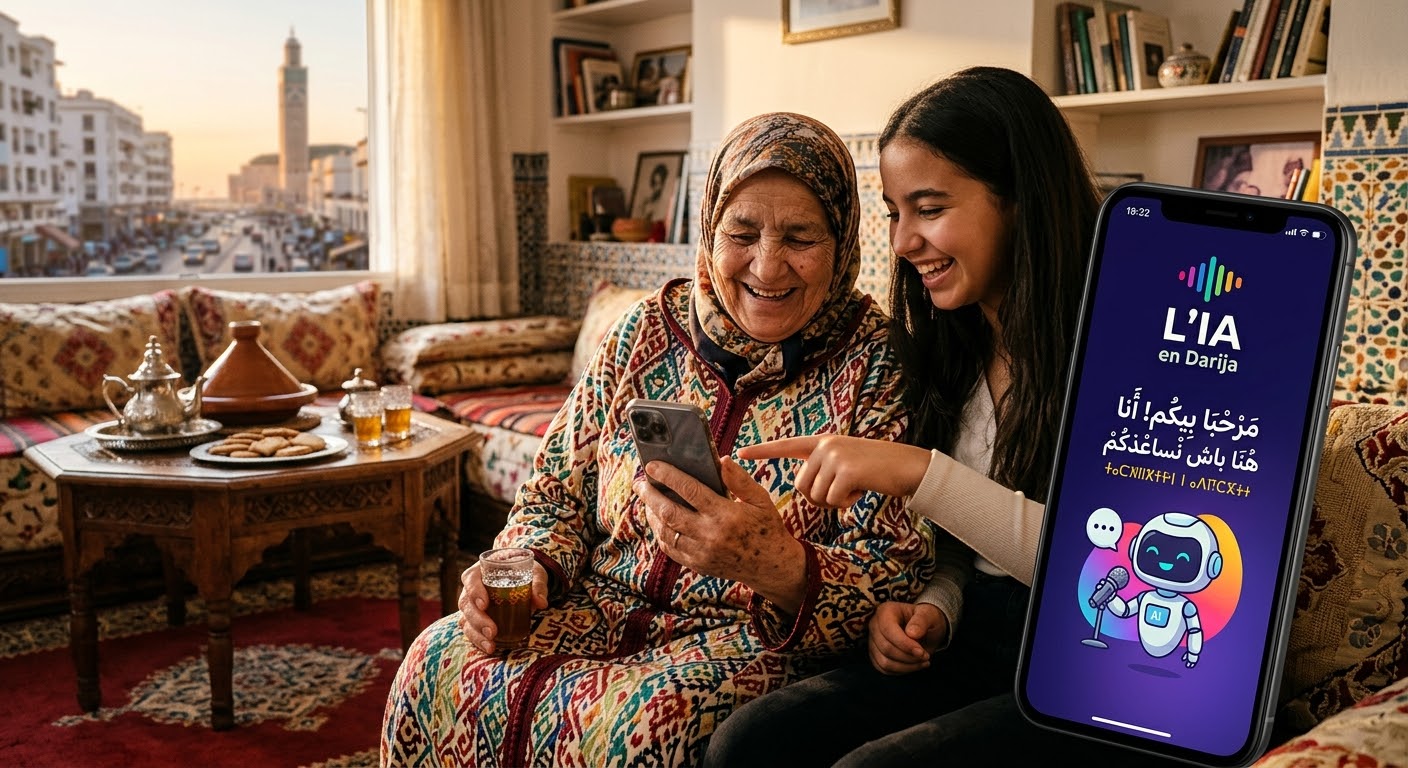
Artificial intelligence in Moroccan Darija has taken a new step forward. The Ministry of Digital Transition and Administrative Reform and Mistral AI have announced the first concrete results of their strategic partnership.
Two tools are now available as open-source resources. The first can identify different varieties of Arabic, including Moroccan Darija. The second, based on Mistral AI’s Voxtral model, converts speech to text and supports conversations where speakers switch between Arabic, French and English.
These developments are part of the Morocco Digital 2030 strategy and the AI Made in Morocco roadmap.
AI in Darija: a first tool to identify Arabic dialects
The first model addresses a key need for language technologies: identifying which language or dialect a speaker is using.
The classifier can recognize and distinguish several Arabic dialects, including Moroccan Darija. This capability can help developers route and process content more accurately depending on the variety of Arabic that is detected.
The broader goal is to reflect the real linguistic practices of Moroccan users in future digital services.
Voxtral adapted to Moroccan Darija and code-switching
The second tool is built on Voxtral, Mistral AI’s automatic speech recognition model.
Its role is to turn spoken content into written text. Crucially, the model has been adapted to Moroccan Darija and can handle situations where speakers alternate between languages.
A Moroccan speaker can, for instance, start a sentence in Darija, insert a French expression and finish in English. This phenomenon, known as code-switching, is common in certain social and professional contexts in Morocco.
The model is specifically designed to take this switching between Arabic, French and English into account.
Why Darija is a key issue for artificial intelligence
AI systems need access to suitable data and models if they are to correctly understand languages and their different regional and social variants.
Moroccan Darija has its own lexical, phonetic and grammatical specificities. On top of that, Moroccans often use several languages in the same conversation.
With these two initial tools, the partnership between Morocco and Mistral AI aims to bring language technologies closer to the way people in the country actually communicate.
According to the ministry, this approach is part of a wider strategy to build sovereign, responsible AI that fits the linguistic and cultural realities of the Kingdom.
Open-source tools for Moroccan developers and innovators
Another key element of the project is how these tools are being made available.
Both technological components are released under open-source licences. This allows public administrations, startups, researchers, developers and companies to integrate them into their own projects, subject to the specific conditions attached to each model.
This openness is intended to make local experimentation easier.
A startup could, for example, use speech recognition to build a service for users who mainly communicate in Darija. A research team could use these resources as a basis for new language models focused on Moroccan Arabic.
What are the possible uses for AI in Darija?
The ministry highlights potential applications across several sectors.
Public services could deploy these technologies to create voice interfaces better aligned with citizens’ everyday language practices. In education, they could support new transcription tools or learning assistants.
Media outlets and private companies could also rely on speech recognition to transcribe audio and video content. Customer support, document digitisation and multilingual data processing are among the other use cases identified.
For now, these remain future possibilities. Their concrete impact will depend on the actual solutions developed on top of these models.
Morocco Digital 2030: AI as a pillar of digital sovereignty
These first two tools sit within a broader national strategy.
The Moroccan government presents Morocco Digital 2030 and the AI Made in Morocco roadmap as frameworks to strengthen national capabilities in digital technologies and artificial intelligence.
The partnership with Mistral AI is also expected to deliver further models and use cases in generative AI, natural language processing, speech recognition and digital public services.
The aim is therefore not only to enable AI systems to “speak Darija”, but also to foster an ecosystem able to build digital tools tailored to Morocco’s realities.
AI that better understands how Moroccans communicate
With these two building blocks, Morocco and Mistral AI are laying the foundations for a technological environment that better supports the languages used every day in the Kingdom.
Dialect identification and speech transcription are two different but complementary functions.
Because they are available as open-source software, Moroccan developers now have the opportunity to design new services on top of them. The next step will be to see how administrations, businesses, startups and research teams adopt and adapt these technologies.
In this way, AI in Darija in Morocco is entering a more tangible phase: after strategic announcements, the first technological components are now available, and further developments are planned under the partnership with Mistral AI.
External sources:
Don’t miss out on the latest news from the diaspora!
Sign up for our next newsletter to receive our practical guides, advice (on procedures and investment) and the latest news for French nationals living abroad, delivered straight to your inbox.