


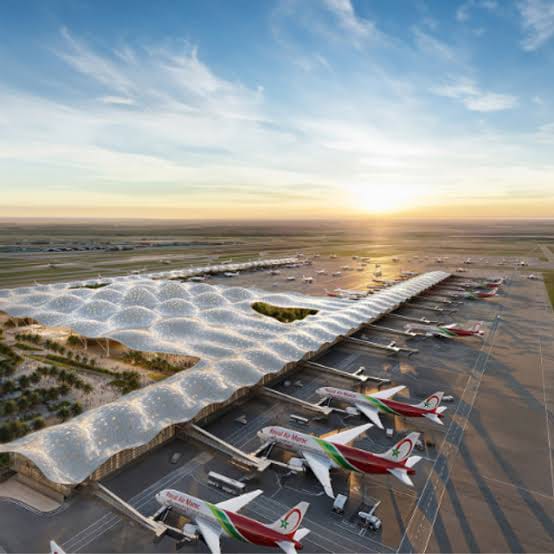
Moroccan airports in Africa are strengthening their position in major continental rankings. In August 2026, Casablanca’s Mohammed V Airport ranked 4th in Africa by seat capacity, while Marrakech-Menara entered the continent’s top 10.
According to data published by the African Airlines Association (AFRAA), Casablanca recorded 803,579 scheduled seats in August. Marrakech registered 480,112.
Moroccan airports in Africa: Casablanca holds on to 4th place
Mohammed V Airport continues to occupy a key position in the African hierarchy.
With 803,579 scheduled seats in August, the Casablanca hub ranks just behind Cairo, Addis Ababa and Johannesburg.
Cairo tops the list with 1,850,926 seats. Addis Ababa follows with 1,251,909 seats, while Johannesburg completes the podium with 1,148,652 seats.
Casablanca therefore stands in 4th place continent-wide, ahead of major hubs such as Algiers, Nairobi, Cape Town and Tunis.
This ranking confirms the role of Mohammed V Airport as a key connector between Morocco, Europe and numerous African destinations.
Marrakech-Menara breaks into Africa’s top 10
Marrakech-Menara completes Morocco’s strong showing in this ranking.
With 480,112 scheduled seats, the airport serving the Red City ranks 10th in Africa for the month of August, ahead of several other major platforms on the continent.
This performance reflects the strong weight of international tourism in Marrakech’s air traffic. The city benefits from a dense network operated by many airlines and connected to several European markets.
Overall, the AFRAA ranking places two Moroccan airports among the top ten in Africa.
African air capacity grows by 8.8%
The performance of the two Moroccan airports comes against a backdrop of growth in African air transport.
In August 2026, available seat capacity on the continent increased by 8.8% year-on-year. Over the same period, intra-African routes posted an even stronger rise.
Their capacity increased by 10.5% compared with August 2025. According to AFRAA, this growth is mainly driven by network expansion, the opening of new routes and the deployment of aircraft with higher capacity.
North Africa accounts for 41.9% of capacity
The geographical breakdown also highlights the weight of North African hubs.
North Africa accounts for 41.9% of total seat capacity recorded in August. East Africa comes next with 22.7%, followed by Southern Africa with 18.3%.
Central and West Africa together account for the remaining 17.1%.
In addition, five North African airports appear in the continental top 10: Cairo, Casablanca, Algiers, Tunis and Marrakech rank among Africa’s leading hubs in terms of scheduled capacity.
African airlines facing strong global competition
The rise in capacity does not mean that African airlines dominate every market segment.
In August, African carriers accounted for 47.2% of international capacity, while non-African airlines held the remaining 52.8%.
On intercontinental routes, the picture is different. AFRAA attributes 62.4% of scheduled capacity to African airlines, versus 37.6% for non-African carriers.
However, traffic data show another balance of power. For intercontinental traffic, African airlines represented 36.7% of measured traffic, compared with 63.3% for other carriers.
Capacity is growing faster than traffic
The gap between capacity and demand is another major challenge for the sector.
According to AFRAA, Available Seat Kilometres (ASK) rose by 9% in July 2026 year-on-year. Over the same period, Revenue Passenger Kilometres (RPK) increased by 5.8%.
Passenger revenues for African airlines also grew by 5.6% in July 2026 compared with June 2025.
Capacity therefore continues to expand rapidly. Carriers now need to turn this additional supply into sustained traffic growth and higher revenue.
Fuel costs remain a key concern
The price of jet fuel continues to weigh heavily on airline operating costs.
For the week ending 21 August 2026, AFRAA estimated the average price of jet fuel at $169.01 per barrel in Africa, compared with $163.87 for the global average.
This gap comes as African airlines are trying to meet rising demand while preserving their profitability.
Casablanca and Marrakech boost Morocco’s air connectivity
The simultaneous presence of Casablanca and Marrakech in the top 10 underlines the diversity of Morocco’s air network.
Casablanca primarily serves as an international connecting hub, while Marrakech relies more on its tourist appeal and its network of direct routes.
Together, they give Morocco two major entry points into African and international air connectivity.
In this context, current dynamics are expected to support the anticipated growth of the continental market. AFRAA estimates that African passenger traffic could grow by an average of 5.8% per year through 2045.
For Moroccan airports, the challenge will be to support this growth with more capacity, better connections and upgraded infrastructure.
External sources:
Don’t miss out on the latest news from the diaspora!
Sign up for our next newsletter to receive our practical guides, advice (on procedures and investment) and the latest news for French nationals living abroad, delivered straight to your inbox.