


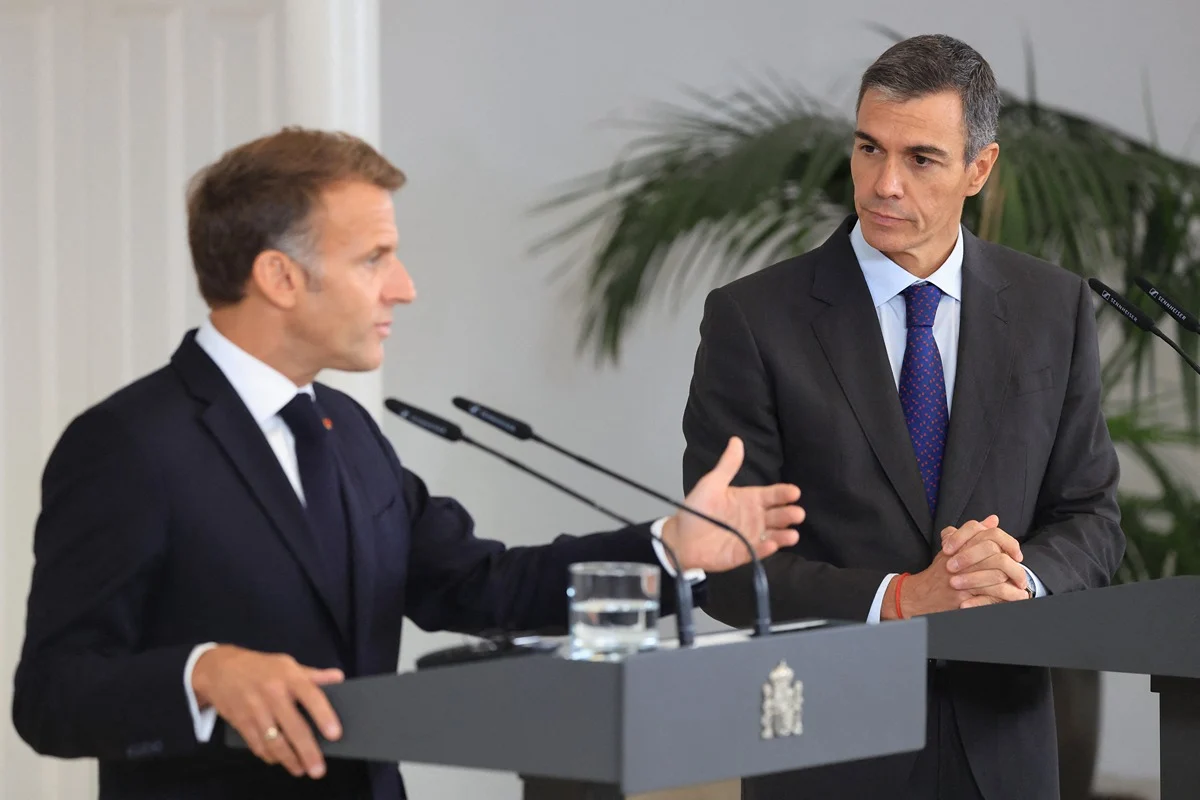
The European debate over borders is hardening after the Sebta migration crisis, with Emmanuel Macron in Madrid firmly backing Spain and calling for stronger protection of the EU’s external frontiers.
Sebta migration crisis at the centre of talks in Madrid
During a visit to Madrid, French President Emmanuel Macron described the late July events in Sebta as an “external and multidimensional attack” against Spain, referring to the mass arrival of migrants from Morocco into the occupied enclave.
Standing alongside Spanish Prime Minister Pedro Sánchez, Macron reaffirmed Paris’s solidarity with Madrid and urged joint European responses. He stressed the need to better secure the EU’s external borders, while remaining within European law and the principles of the asylum and migration pact.
For Moroccans who regularly transit through Spain to return home or travel back to Europe, these statements confirm that the Sebta migration crisis will not be treated as an isolated incident. It is likely to influence future border-control policies.
What could change for travel through Sebta and Spain?
In practical terms, nothing changes immediately for travellers with regular documents. Maritime and air links between Morocco and Spain are operating normally, and no new measures targeting legal travel have been announced so far.
However, several ideas being discussed at EU level could, in the medium term, affect the travel habits of Moroccans living abroad:
- tighter checks at land borders, especially around Sebta and Melilla;
- increased surveillance resources at the EU’s external borders;
- stronger pressure on countries of origin and transit to limit irregular departures;
- closer coordination between member states when managing migration crises.
If these orientations are translated into concrete measures, informal land crossings are likely to face more pressure. By contrast, travellers holding visas, residence permits or EU passports should mainly experience stricter checks at border posts, without any change to their basic right to move.
A tougher line, still framed by European law
Beyond the Sebta migration crisis, Emmanuel Macron insisted on the need for a balance between responsibility and solidarity in implementing the European asylum and migration pact. He called for better coordination between member states to prevent sudden crises like the one in July.
The French president also urged wider use of existing EU tools in dealings with countries of origin and transit. The declared aim is to reduce irregular arrivals, while reinforcing resources allocated to monitoring the Union’s external borders.
On the Spanish side, the government has announced stronger security arrangements in Sebta and measures to organise reception and follow-up for those who arrived in July. The episode remains under judicial scrutiny, with Sebta’s local president, Juan Jesús Vivas, heard by the National Court as part of the investigation into how the crisis was managed.
What Moroccans abroad should keep an eye on
For Moroccans settled in Europe who often use routes through Spain to reach Morocco, the main issue is less an immediate disruption to travel than a tougher political climate around migration.
In the coming months, it will be useful to:
- monitor changes in EU rules on visas and border checks;
- regularly check travel conditions with airlines and ferry operators, such as Royal Air Maroc;
- book earlier for peak seasons, especially the summer holidays.
For now, legal travel between Europe and Morocco continues under usual conditions. But the signal from Madrid is clear: the this case will weigh more heavily in EU border debates, with possible long-term effects on how Moroccans abroad plan their journeys.
Those who want to go further on procedures and travel options can refer to Canal212’s practical guide for Moroccans living abroad.
For more context, readers can follow Canal212 news for Moroccans abroad.
Don’t miss out on the latest news from the diaspora!
Sign up for our next newsletter to receive our practical guides, advice (on procedures and investment) and the latest news for French nationals living abroad, delivered straight to your inbox.