


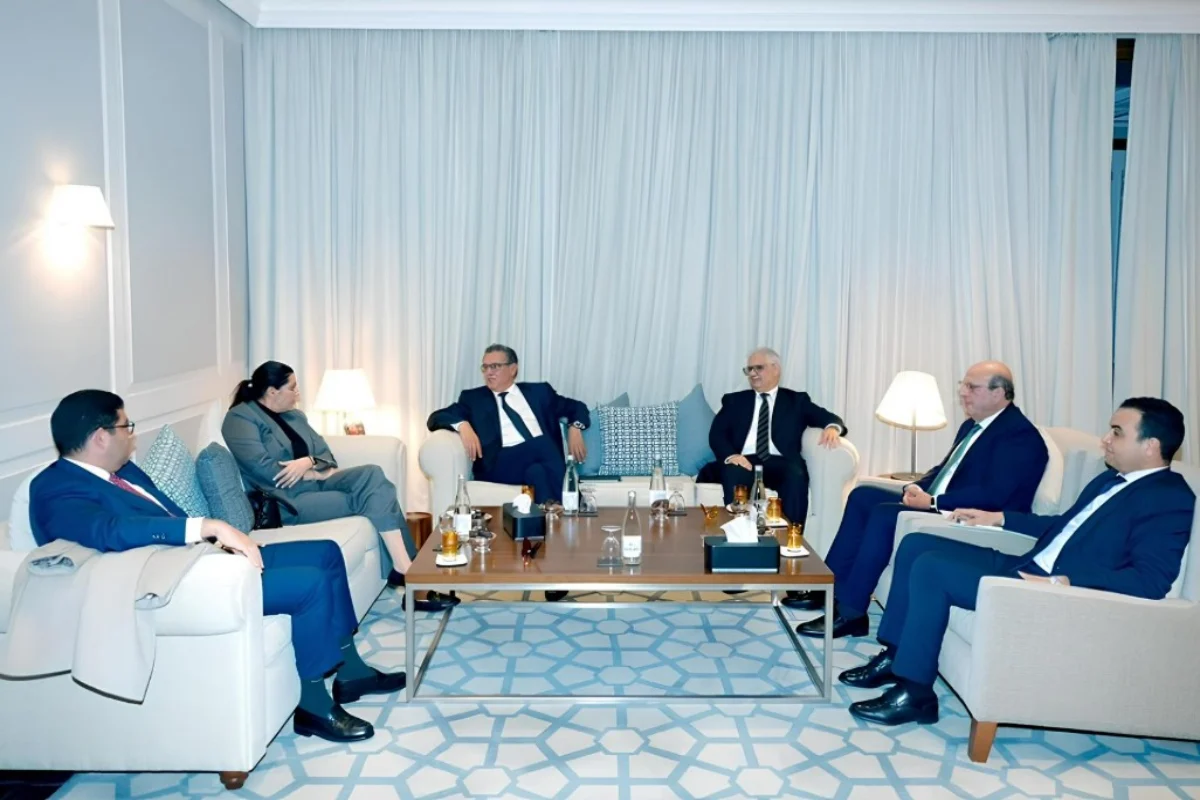
This update focuses on Morocco government coalition. Morocco has entered a crucial phase of negotiations to form its next government, after the Party of Authenticity and Modernity (PAM) won the legislative elections with 97 out of 395 seats.
Morocco government coalition: a Parliament without a majority
The new political map places the PAM in first position, followed by the National Rally of Independents (RNI) with 66 seats and the Istiqlal Party with 65 seats. The Justice and Development Party (PJD) comes fourth with 54 seats.
No party can govern alone. An absolute majority in the House of Representatives requires 198 seats. Any Morocco government coalition will therefore have to rely on alliances between several parties.
The Constitution sets the framework for the first step. Article 47 provides that the Head of Government is appointed from the party that came first in the elections. Only after that does the consultation phase with other parties begin.
Coalition scenarios on the table
For analysts, these talks must be read first through the numbers produced by the ballot box. The PAM’s victory is the starting point, but its 97 seats fall well short of a majority.
The simplest scenario, mathematically, would be to renew the outgoing majority made up of the PAM, the RNI and Istiqlal. Together, these three parties would comfortably cross the 198-seat threshold.
Such a formula would ensure a certain continuity in government, but with a deeply reshaped balance of power. The PAM, now the largest parliamentary group, would lead the coalition, whereas the RNI previously played the central role.
Other formulas remain possible. The PAM could, for example, seek an alliance with Istiqlal and several medium-sized parties, building a broader majority that still secures parliamentary stability while bringing in diverse political profiles.
Coherence and stability will be key
Beyond arithmetic, the real challenge is political and programmatic coherence. A fragmented government could struggle to deliver on major economic, social or institutional reforms.
Key areas for future bargaining include:
- economic and social priorities for the upcoming term;
- the continuation of major state reform projects;
- long-term public policies, including measures affecting the business climate and public services.
For Moroccans living abroad, the core question is less about party labels than about policies. The shape of the Morocco government coalition will influence whether current orientations are maintained or adjusted: improvement of consular services, simplification of procedures in Morocco, investment conditions, and the preparation of major national projects and events.
While the appointment of the Head of Government and the announcement of the cabinet are still pending, the diaspora can read this process as an indicator of political stability and of the state’s capacity to stay on course with reforms.
For concrete procedures, it remains advisable to rely on official information from the competent institutions, in particular the website of the ministry in charge of Moroccans living abroad, and to consult practical tools such as Canal212’s guide to key procedures for MREs.
What room for manoeuvre in the next term?
The coming weeks will be decisive in determining which this case ultimately emerges. A compact coalition around three major parties could favour clarity and stability. A broader alliance would include more political sensitivities, at the risk of slower negotiations on core reforms.
In any case, the next government will have to work with a fragmented Parliament and high expectations on public services, purchasing power and the quality of the relationship between the state and its citizens, including those who live outside the country.
For more context, readers can follow Canal212 news for Moroccans abroad.
Don’t miss out on the latest news from the diaspora!
Sign up for our next newsletter to receive our practical guides, advice (on procedures and investment) and the latest news for French nationals living abroad, delivered straight to your inbox.