


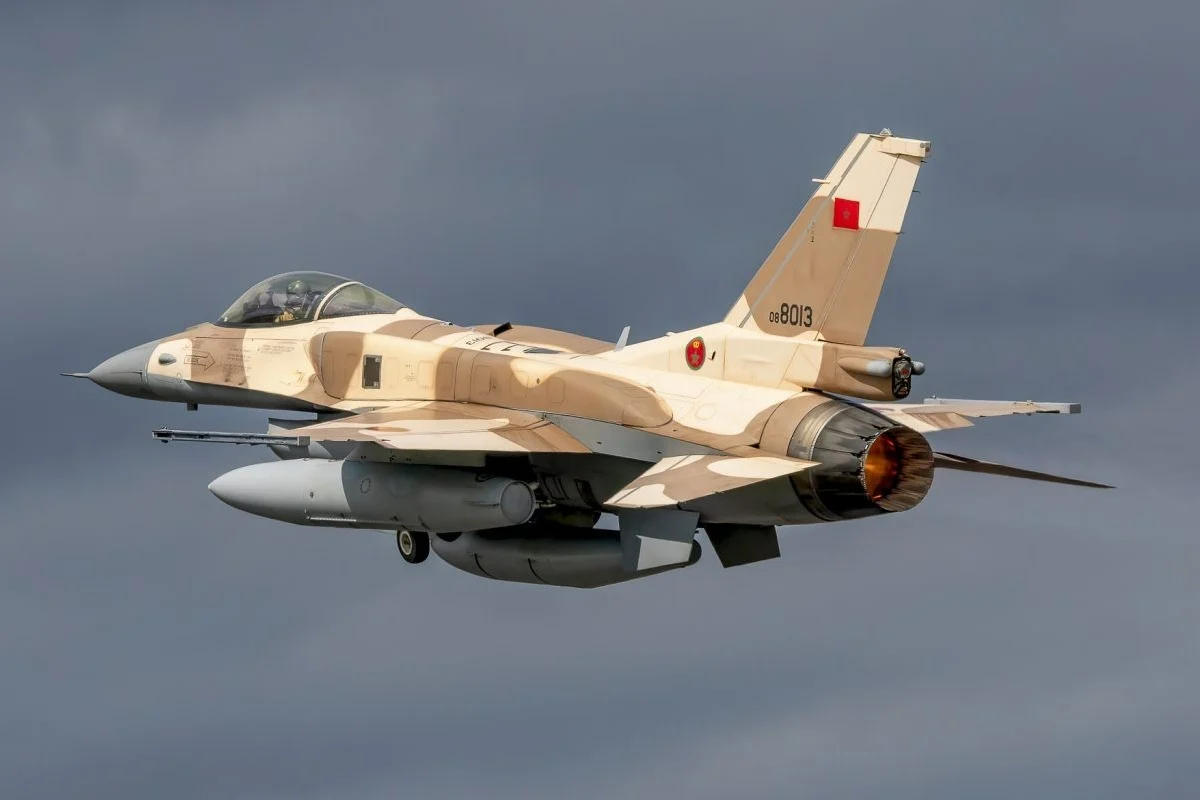
This update focuses on Morocco F-16 simulators. Morocco is set to upgrade the training of its fighter pilots with two new full‑mission simulators for its F-16 Block 72 jets, under a contract worth up to $42.1 million awarded to Canadian group CAE.
Morocco F-16 simulators: a key training contract
According to information released by the US Department of Defense, CAE has secured a contract to supply the Royal Moroccan Air Force with two full‑mission simulation systems for F-16 Block 72 aircraft, along with a package of logistical support services.
The overall value of the deal can reach $42.1 million. Nearly $38 million has been committed upon award under the US Foreign Military Sales (FMS) mechanism, which governs the sale of military equipment to partner countries.
Work will be carried out in Arlington, Texas, and at the Sidi Slimane air base in Morocco. Completion is expected no later than 30 April 2029.
Two simulators for a modernising fleet
This project is part of the ongoing modernisation of Morocco’s F-16 fleet. The two new Morocco F-16 simulators are designed to recreate, in a virtual environment, the real operational conditions of flying and fighting in an F-16 Block 72.
Each simulation system will include in particular:
- a cockpit replicating that of the F-16 Block 72;
- workstations for instructors and operators;
- an advanced visual display system;
- powerful computing and processing capabilities;
- a dedicated power distribution unit;
- a targeting and training system adapted to modern missions.
The aim is to enable intensive, realistic and safer training, without constantly deploying real aircraft or consuming fuel and live ammunition.
Security and what it means for Moroccans abroad
By relying on these Morocco F-16 simulators, the air force expects to strengthen the operational readiness of its crews, especially for complex scenarios and challenging environments. Simulated missions also make it possible to train for situations that would be too risky to reproduce in real flight.
For Moroccans living abroad, this investment signals a clear intention from the authorities to bolster national defence and airspace surveillance. A better trained air force is a central element of long‑term stability, which matters for those who travel regularly, plan to invest, or consider returning to settle in the country.
This upgrade of Morocco’s F-16 fleet, combined with new training tools, is part of a broader equipment modernisation effort carried out with several international partners, including the United States. The reinforced training pillar should help make the most of the latest aircraft that have been ordered or are being delivered.
Full technical details of the contract, including the exact configuration of the simulators and the detailed deployment schedule at Sidi Slimane, have not been made public so far and still need to be confirmed by the relevant authorities.
For more context, readers can follow Canal212 news for Moroccans abroad.
For official updates, readers can check the relevant official source.
Don’t miss out on the latest news from the diaspora!
Sign up for our next newsletter to receive our practical guides, advice (on procedures and investment) and the latest news for French nationals living abroad, delivered straight to your inbox.