


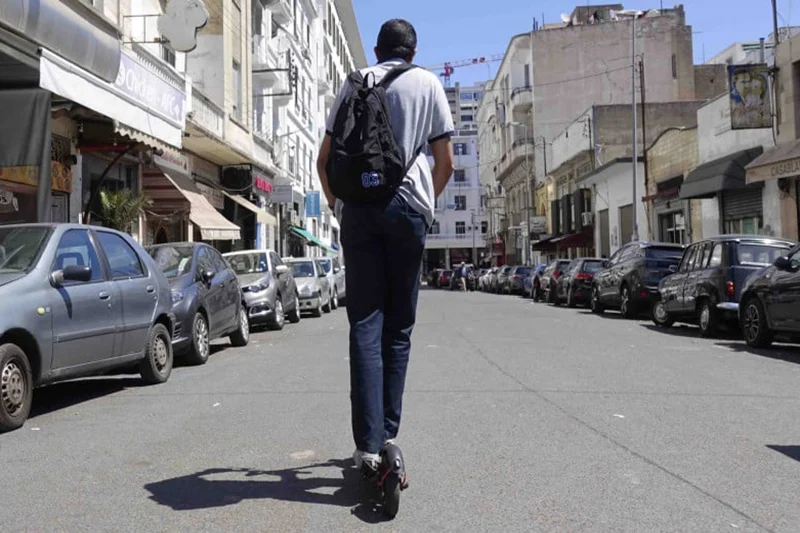
This update focuses on Electric scooters Morocco. Morocco has now officially regulated electric scooters and electric-assist bicycles, setting speed limits, clear definitions and new usage rules.
Electric scooters Morocco: a long-awaited legal framework
Published in the Official Bulletin, Decree No. 2.24.393 dated 10 rabii II 1447 (3 October 2025) amends how the Road Code is applied to vehicles. It updates Decree No. 2.10.421 of 29 September 2010 on the implementation of Law No. 52.05.
The text introduces, for the first time, a legal definition for personal motorised mobility devices such as electric scooters, as well as for electric-assist bicycles. It also adjusts the list of vehicles exempted from certain control devices.
For Moroccans living abroad who use these devices during their stays in the country, this new framework finally clarifies what is allowed and what is prohibited on public roads.
What counts as an electric scooter and how fast it can go
The decree defines a personal motorised mobility device as a vehicle without a seat, designed to carry only one person. It cannot be equipped for transporting goods. It must have a steering system and be fitted with a non-thermal motor or assistance system.
Electric scooters clearly fall under this definition. Their speed is strictly regulated: it must be higher than 6 km/h but may not exceed 25 km/h.
The goal is to reduce the risk of accidents, especially in dense urban areas where these devices are spreading quickly. Police checks will now rely on this new legal basis.
Electric-assist bicycles get a clear status
The decree also defines electric-assist bicycles. These are vehicles with at least two wheels and equipped with an auxiliary electric motor with a power output of 250 watts or less.
Assistance must stop when the cyclist stops pedalling or when the bike exceeds a certain speed threshold set by the text. The motor must not fully replace the rider’s effort.
This clarification matters for importers and for Moroccans abroad who plan to bring or buy an electric-assist bicycle in Morocco. It will affect approval procedures, insurance and use on public roads.
Immediate entry into force, with a 6‑month grace period
The decree took effect as soon as it was published in the Official Bulletin. However, provisions relating to personal motorised mobility devices and electric-assist bicycles benefit from a six-month delay before they are fully enforced.
This grace period should help users, rental operators and local authorities adapt to the new rules. It also gives the administration time to organise communication and, if needed, clarify practical details.
For Moroccans living abroad, this means that rules may change from one trip to the next. Before travelling with an electric scooter or e-bike, it will be wise to check updated guidance from the relevant authorities or transport companies.
Exemptions for public security and military vehicles
The text also expands the list of vehicles exempted from the obligation to install devices that record speed and driving time. It now includes vehicles of the National Police, Royal Gendarmerie, Auxiliary Forces and Royal Armed Forces.
This measure concerns the state vehicle fleet and does not directly affect private drivers, including Moroccans returning for holidays or longer stays.
Key takeaways for residents and visitors
For regular users and Moroccans abroad visiting the country, several points stand out:
- Electric scooters are now explicitly covered by the Road Code.
- Speed must stay between 6 km/h and 25 km/h.
- Electric-assist bicycles have a precise legal definition.
- A six-month transition period is set before full enforcement.
Detailed rules on using these devices on the roadway, bike lanes or pavements should be clarified by implementing texts and circulars. Until then, caution remains essential, especially in big cities where coexistence with pedestrians and cars is often difficult.
Moroccans living abroad who plan a return or holidays with this kind of device have every reason to follow how these rules evolve via official administration portals or their insurance providers.
For more context, readers can follow Canal212 news for Moroccans abroad.
For official updates, readers can check the relevant official source.
Don’t miss out on the latest news from the diaspora!
Sign up for our next newsletter to receive our practical guides, advice (on procedures and investment) and the latest news for French nationals living abroad, delivered straight to your inbox.