


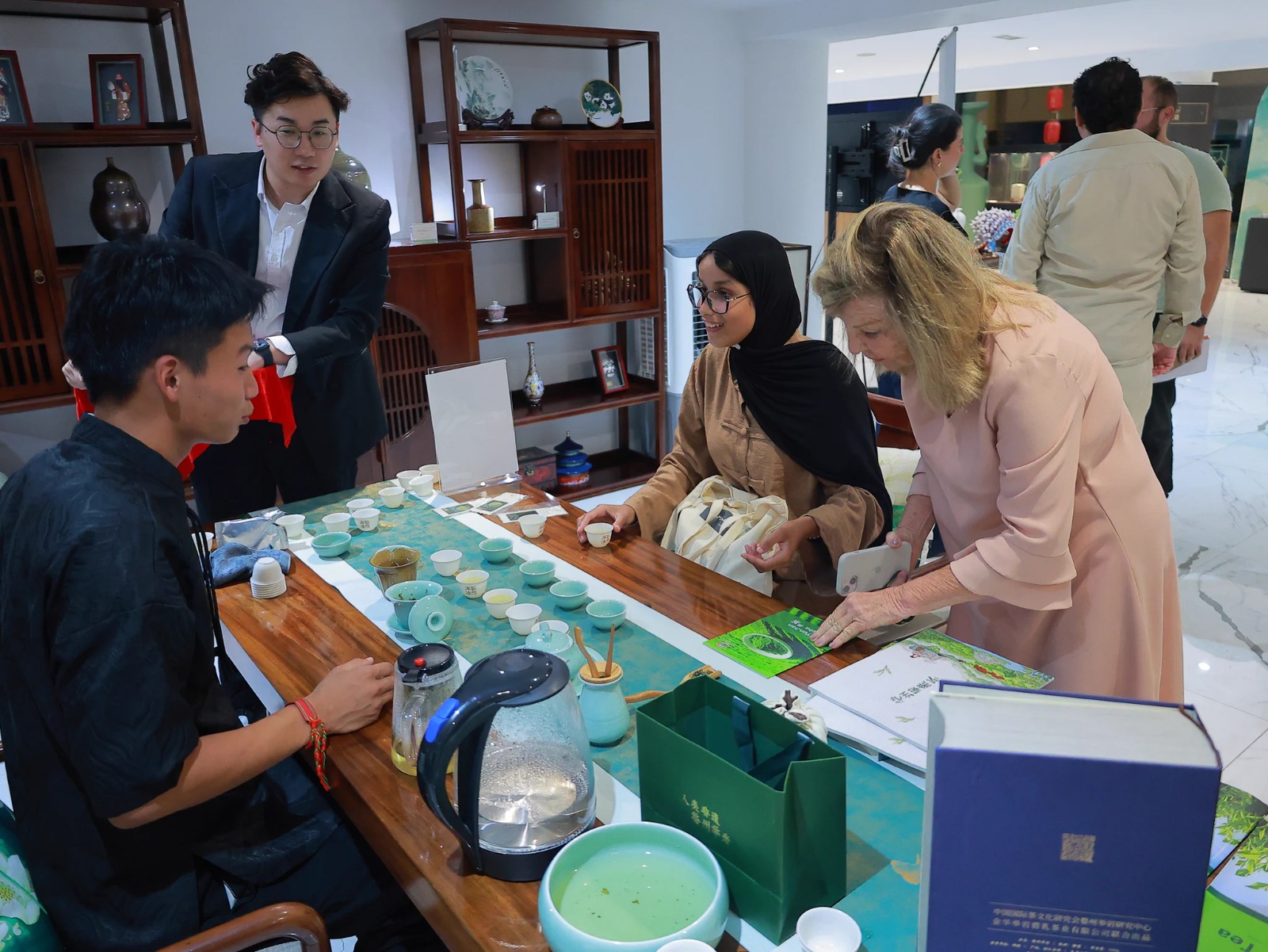
The exhibition Chinese celadon in Rabat runs until 30 September at the China Cultural Center in Rabat. Titled “A Green Breeze from the Sea”, it highlights ceramics from China’s Zhejiang province and their famous jade-like green shades.
Opened on 10 September, the exhibition invites visitors to discover an age-old craft that has travelled far beyond China’s borders. It also tells a story of cultural exchange along the Maritime Silk Road.
Chinese celadon in Rabat: a journey through the centuries
The exhibition traces the evolution of Zhejiang ceramics across different historical periods.
Celadon is especially known for its green and jade tones, obtained through glazing and firing techniques perfected over the centuries.
These pieces bear witness to an artistic tradition that combines aesthetic research, artisanal know-how and a close relationship with nature.
In Rabat, visitors can discover different facets of this Chinese heritage.
Ceramics at the heart of the Maritime Silk Road
The exhibition does more than tell the story of an art form.
It also recalls the role played by Chinese ceramics in trade and cultural exchanges between Asia, Africa and Europe.
Pieces produced in Zhejiang travelled by sea and helped forge connections between distant regions.
This historical dimension gives the exhibition particular resonance in a country like Morocco, itself located at the crossroads of major trade routes.
China and Morocco: a dialogue through ceramics
At the opening, China’s ambassador to Morocco, Yu Jinsong, underlined the cultural significance of celadon.
She also mentioned similarities between certain Chinese and Moroccan artistic traditions.
The blue of Fez, Moroccan zellige tilework and Chinese ceramics all reflect, in their own way, meticulous work on colour, material and geometry.
The exhibition thus creates a dialogue between two artistic traditions that have each developed original forms to beautify everyday objects.
Ibn Battuta, witness to exchanges with China
The history of these exchanges goes back several centuries.
During the opening, archaeologist Fatima Ait Mhand from the National Institute of Archaeology and Heritage Sciences recalled the role of ceramics in exchanges between civilizations.
She referred in particular to the accounts of Ibn Battuta. The famous Moroccan traveller himself described the importance of Chinese porcelain in the trade of his time.
These accounts are a reminder that works of art have long accompanied travellers, merchants and exchanges between peoples.
Chinese craftsmanship in the spotlight
China remains globally renowned for its expertise in ceramics.
Glazing, enamelling and firing are among the techniques that have evolved over generations.
Celadon holds a special place in this history. Its subtle shades and jade-like appearance have contributed to its fame.
The Rabat exhibition allows visitors to better understand the skill and work behind these objects.
An exhibition open until 30 September
The Chinese celadon in Rabat exhibition offers an encounter between art, history and cultural exchange.
Hosted at the China Cultural Center, “A Green Breeze from the Sea” remains open to the public until 30 September 2026.
Through the works on display, the event above all shows how artistic traditions can cross borders and build bridges between cultures.
External sources:
Don’t miss out on the latest news from the diaspora!
Sign up for our next newsletter to receive our practical guides, advice (on procedures and investment) and the latest news for French nationals living abroad, delivered straight to your inbox.