


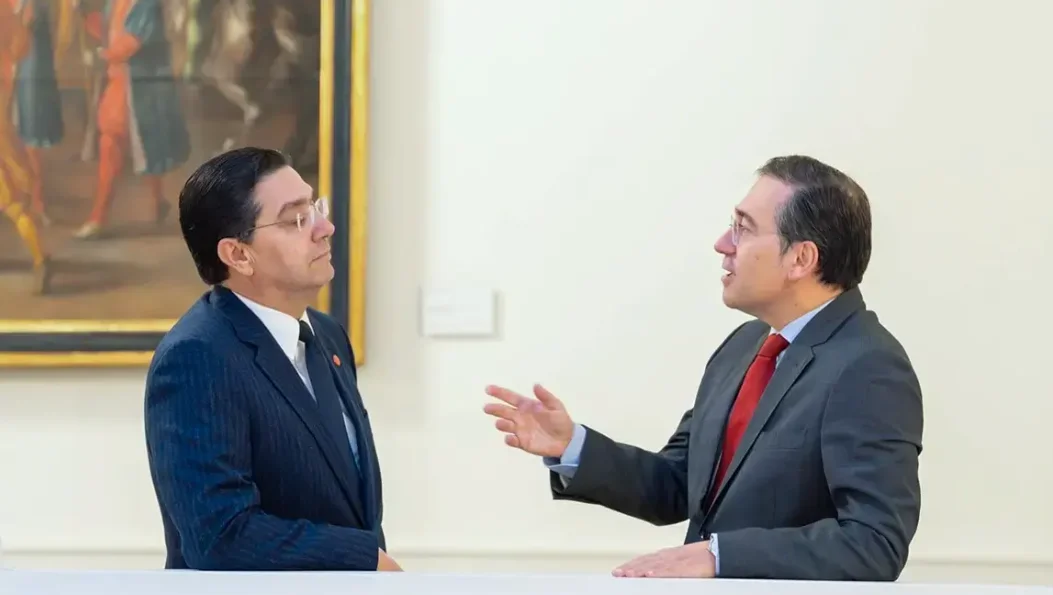
This update focuses on Ceuta Melilla Bourita Albares. Recent clarifications between Nasser Bourita and José Manuel Albares over Ceuta and Melilla shed light on a tense episode without changing, for now, the practical rules of mobility between Morocco and Spain.
Ceuta Melilla Bourita Albares: a call to cool tensions
Spanish Foreign Minister José Manuel Albares used an interview on public channel La 1 to detail a recent exchange with his Moroccan counterpart Nasser Bourita. At stake were comments by Moroccan ministers on Ceuta and Melilla that Madrid considered “totally unacceptable” and “damaging to bilateral relations”.
According to Albares, Bourita said these statements were made in an “electoral context” and did not reflect Morocco’s official position. The ministers involved were speaking as party representatives, not as the voice of the government’s foreign policy.
Albares says he reiterated Spain’s position very clearly: “Ceuta and Melilla are Spanish. We have not discussed with Morocco, we are not discussing and we will never discuss our territorial integrity.” The message underlines Madrid’s red lines while keeping open a direct channel with the Moroccan foreign minister.
What it means for mobility and Moroccans abroad
For Moroccans living abroad, the obvious question is whether this Ceuta Melilla Bourita Albares episode will affect their travel plans, returns home or cross-border investments involving Spain.
So far, neither Rabat nor Madrid has announced any change to border arrangements. There are no new measures regarding visas, checks or access to Ceuta and Melilla. Sea and air connections between the two shores continue to operate under existing rules.
In practice, these clarifications remain political and symbolic rather than operational. They are about managing diplomatic tensions and campaign rhetoric, not rewriting mobility rules overnight.
For Moroccans abroad who transit through Spain to reach Morocco, the real issue remains the overall stability of Moroccan‑Spanish cooperation, especially on:
- border management and migration flows;
- security coordination in the Strait of Gibraltar and the Mediterranean;
- the smooth running of crossings, particularly in the summer season.
On all these fronts, both capitals keep stressing publicly how strategic their partnership is, even when a sovereignty issue briefly revives sensitive debates.
Mass crossings to Ceuta and the role of social media
José Manuel Albares also addressed the late July crossings of migrants towards Ceuta. He said he had contacted Nasser Bourita, who assured him that Morocco “was not behind what happened” and that Moroccan authorities had deployed the necessary resources to stop the inflow.
The Spanish minister stated that his government still does not know who orchestrated the attempt. However, he mentioned “unusual activity” on social networks on 30 July, spreading the idea that the border was open.
He linked this wave of messages to a distorted reading of a Supreme Court ruling dated 8 July. According to him, social networks were “the final spark” that pushed thousands of people towards Ceuta.
For Moroccans abroad, this is a reminder of how essential it is to verify information before planning any move towards a sensitive border crossing, whether Ceuta, Melilla or another point of entry. Spanish authorities have indicated that investigations are still under way to establish the facts and, if needed, announce specific measures.
Looking ahead: stay informed, avoid panic
The Ceuta Melilla Bourita Albares sequence shows how fragile Moroccan‑Spanish relations can be whenever sovereignty issues come back to the surface. It also confirms that both foreign ministers still rely on direct communication to contain diplomatic fires.
For Moroccans living abroad, a cautious approach means:
- following official announcements before changing itineraries or long‑term plans;
- treating viral posts promising “open borders” overnight with extreme caution;
- using institutional channels for information on travel, returns and administrative procedures.
In the absence of new official decisions, the framework for mobility remains unchanged. What needs to increase is vigilance, particularly online, where rumours can quickly turn into pressure on borders and generate new diplomatic friction.
For more context, readers can follow Canal212 news for Moroccans abroad.
For official updates, readers can check the relevant official source.
Don’t miss out on the latest news from the diaspora!
Sign up for our next newsletter to receive our practical guides, advice (on procedures and investment) and the latest news for French nationals living abroad, delivered straight to your inbox.