


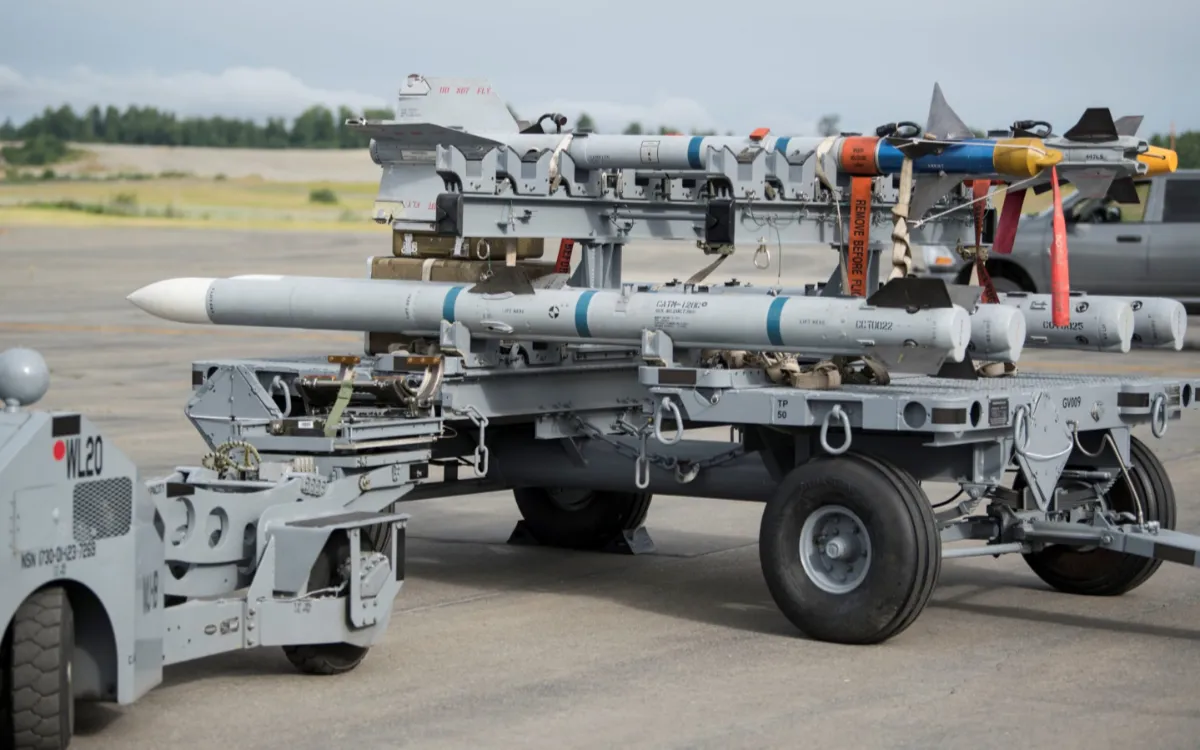
This update focuses on AMRAAM missiles Morocco. Morocco is one of 29 countries included in a new $105.6 million U.S. contract for AMRAAM missile components, but no official information has been released so far on the exact share reserved for Rabat.
AMRAAM missiles Morocco within a global contract
According to a notice from the U.S. Department of Defense, defense contractor Raytheon has received a contract modification worth precisely $105,646,856. The deal covers the purchase of parts for AMRAAM air‑to‑air missiles.
The contract, awarded on 22 September, extends an existing agreement and will be carried out in Tucson, Arizona, until 31 August 2027. It is therefore not a stand‑alone order by Morocco, but a pooled purchase for U.S. forces and several partner countries.
The overall breakdown of funding is known: the bulk of the envelope goes to the U.S. military, with $61.59 million for the U.S. Air Force and $8.39 million for the U.S. Navy. Foreign military sales account for $35.65 million.
A pooled purchase with 28 other countries
The foreign component of the contract brings together 29 states, including Morocco. Among them are Argentina, Australia, Germany, Israel, Japan, Saudi Arabia, Spain, Türkiye, the United Arab Emirates and the United Kingdom.
However, the U.S. document does not break down the $35.65 million among the various customers. No precise number of missiles or parts allocated to the Royal Moroccan Air Force is mentioned in the public notice.
The $105.6 million figure should therefore not be read as a new order of that amount placed solely by Rabat. It refers to a common basket of AMRAAM components, intended for several allied air forces, including Morocco’s F‑16 fleet.
Gradual modernisation of Morocco’s F‑16s
This deal comes as AMRAAM missiles Morocco are already part of a broader effort to modernise the kingdom’s air defence. U.S. authorities have previously authorised the sale of AIM‑120C‑8 AMRAAM missiles to Morocco.
An earlier notification to the U.S. Congress allowed Rabat to purchase up to 30 AMRAAM missiles, for an estimated amount of $88.37 million. That authorisation concerns the armament of Moroccan F‑16s and aims to strengthen their interception and air defence capabilities.
The new $105.6 million contract fits into this trajectory: it does not launch a separate, clearly defined sale to Morocco, but helps secure the availability of parts and components for all AMRAAM users.
What does this mean for Moroccans living abroad?
For Moroccans living abroad, this development does not directly affect administrative procedures, travel to Morocco or civilian investment plans. It mainly relates to defence policy and the state’s strategic choices.
However, it is part of a broader context that many in the diaspora follow closely: Morocco’s stability and military credibility in its regional environment. A country that maintains modern defence capabilities can strengthen its image as a reliable partner, which matters for business, investment and tourism.
Several key points remain unknown at this stage:
- the exact value of AMRAAM components to be billed to Morocco;
- the precise number of parts destined for the Royal Moroccan Air Force;
- the detailed delivery timetable.
These elements may be clarified later, either by U.S. authorities or by the relevant Moroccan institutions. For now, the contract confirms a deeper trend: Rabat continues to equip its F‑16s with advanced U.S. weaponry within a close security partnership with Washington.
For Moroccans abroad who pay attention to the kingdom’s long‑term choices, this is less a turning point than another step in the progressive modernisation of Morocco’s armed forces.
For more context, readers can follow Canal212 news for Moroccans abroad.
For official updates, readers can check the relevant official source.
Don’t miss out on the latest news from the diaspora!
Sign up for our next newsletter to receive our practical guides, advice (on procedures and investment) and the latest news for French nationals living abroad, delivered straight to your inbox.