


On 10 September 1844, Morocco and France signed in Tangier a peace agreement that became known as the Tangier Treaty 1844, a key turning point in bilateral relations and in drawing the Moroccan‑Algerian border.
From occupied Algeria to the “first war of Morocco”
In the early 1840s, colonial France was trying to consolidate its grip on Algeria after the 1830 expedition. Facing French expansion, Emir Abdelkader led a determined and organised resistance.
Around 1842, weakened by military pressure, Abdelkader openly sought support from the Sultan of Morocco, Moulay Abderrahmane. He crossed into Moroccan territory in the east, where several tribes backed him with shelter and logistics.
Paris interpreted this support as direct interference. The French consul in Morocco sent a firm warning to the royal court in Fez, demanding that the kingdom stop hosting and aiding Abdelkader, portrayed as a threat to the border France claimed to have inherited from the Ottoman Empire.
Moulay Abderrahmane rejected the ultimatum. Tensions escalated rapidly and, in the summer of 1844, led to what historians would later call the “first war of Morocco”.
Bombardment of Tangier, occupation of Mogador and the battle of Isly
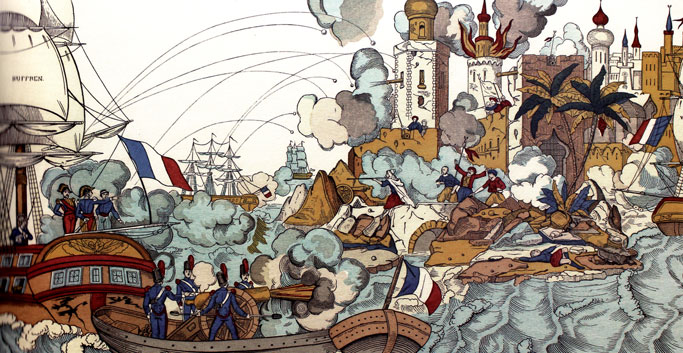
In August 1844, France put its threats into action. A naval squadron bombarded Tangier on 6 August in the early morning. Several French warships shelled the city from the sea, while hundreds of Moroccan defenders tried to respond from the coast.
In the following days, military pressure increased. The port city of Mogador (Essaouira) was occupied. On land, French forces clashed with the Cherifian army in the battle of Isly, near Oujda. The confrontation ended in a French victory, revealing its material and organisational superiority.
These setbacks placed Morocco in a fragile position. The kingdom had to deal with an unfavourable balance of power while trying to preserve its sovereignty and its role as protector of the border populations linked to Abdelkader.
The Tangier Treaty 1844 and its consequences
In this context, the Tangier Treaty 1844 was signed on 10 September. The agreement ended open hostilities with France and formally put an end to Moroccan support for Emir Abdelkader.
The peace text addressed the question of the eastern border and prepared the ground for a more detailed settlement. That settlement came the following year with the Lalla Maghnia agreement, concluded in 1845, which more precisely defined the borderline between Morocco and French‑dominated Algeria.
For Morocco, the compromise had a political and symbolic cost. The kingdom gave up backing a major resistance leader in the region and accepted a border framework largely imposed by the colonial power.
Prelude to the French Protectorate
Historians and specialists often regard the Tangier Treaty 1844 as a prelude to the French Protectorate over Morocco, officially established in 1912. The agreement illustrates the growing external pressures the kingdom faced throughout the 19th century.
Several long-lasting effects stemmed from this moment:
- stronger French control over Morocco’s eastern border;
- a reduced political and military role for the kingdom in the region;
- a diplomatic precedent later used to justify new interventions.
For Moroccans living abroad, this episode sheds light on the long history of power struggles that shaped the Maghreb and the current Moroccan‑Algerian border, which lies at the heart of many family stories and migration routes.
By recalling the events of 10 September 1844, this date invites a fresh reading of 19th‑century Moroccan history as a sequence of negotiations, resistance and compromise in the face of European colonial ambitions.
For more context, readers can follow Canal212 news for Moroccans abroad.
For official updates, readers can check the relevant official source.
Don’t miss out on the latest news from the diaspora!
Sign up for our next newsletter to receive our practical guides, advice (on procedures and investment) and the latest news for French nationals living abroad, delivered straight to your inbox.