


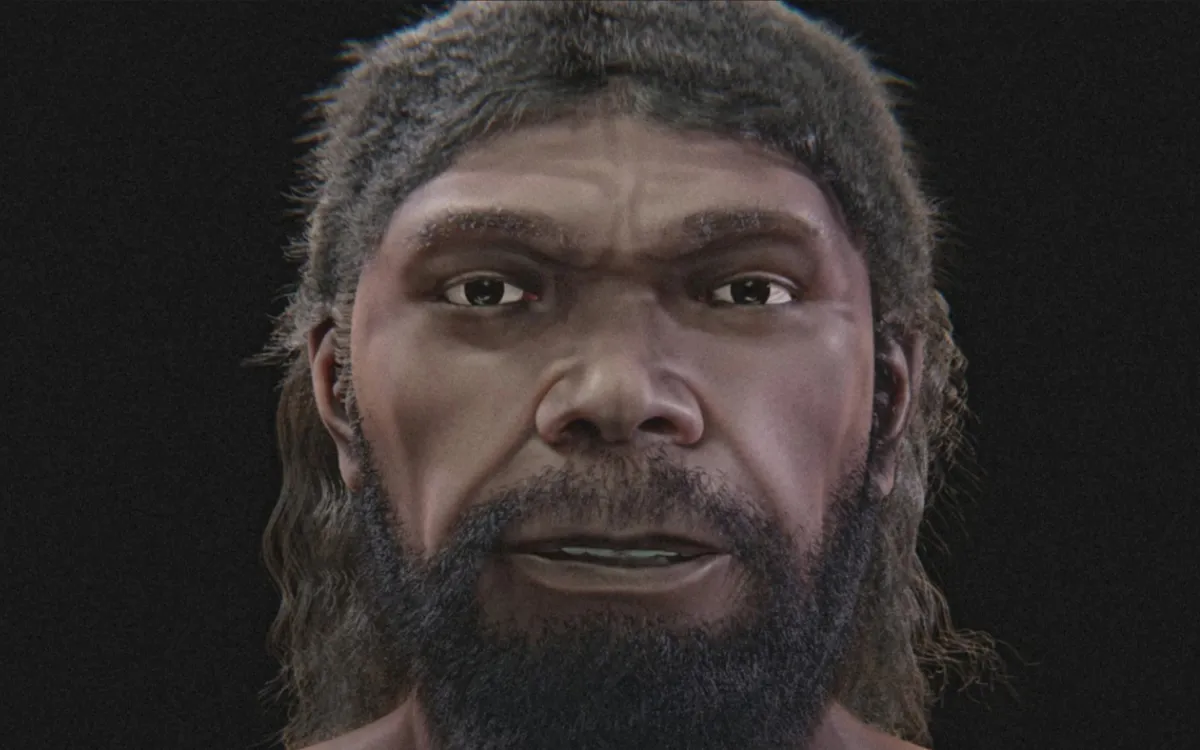
What might a Homo sapiens who lived in Morocco around 315,000 years ago have looked like? A new study offers a visual answer thanks to a digital reconstruction based on fossils from Jbel Irhoud, in the province of Youssoufia.
An international team led by Brazilian specialist in digital facial approximation Cicero Moraes published its findings on 13 September 2026 in the scientific journal Heritage. The researchers used a digital model of a composite skull from the Moroccan site to propose an approximation of the face of this ancient representative of our species.
Jbel Irhoud: a 315,000‑year‑old human face
The Jbel Irhoud fossils are among the oldest remains attributed to Homo sapiens. Research published in 2017 dated them to around 315,000 years, overturning previous ideas about the early stages of our species’ evolution.
The Moroccan site is particularly significant because the fossils already show several facial features similar to those of present‑day humans, while the shape of the braincase still displays more ancient traits.
This combination of characteristics has made Jbel Irhoud a key site for understanding the evolution of Homo sapiens in Africa.
A composite skull at the heart of the reconstruction
The researchers did not work from the complete skull of a single individual.
The digital model is based mainly on the fossil known as Irhoud 1, discovered in 1961. The team complemented it with other elements from fossils found in the same archaeological layer, notably a mandible and dental remains.
The scientists then produced a three‑dimensional model using data and digital images made publicly available by the Max Planck Institute for Evolutionary Anthropology.
This method allowed them to obtain a coherent cranial structure on which to apply facial approximation techniques.
How did researchers reconstruct the face?
The team used a 3D scan of a contemporary adult as a starting template. They then digitally deformed this model to adapt its bony structure to that of the Jbel Irhoud skull.
The soft tissues were transformed accordingly. The researchers also relied on modern anatomical data to estimate the thickness of facial tissues.
The result is an anatomically plausible approximation of the overall shape of the face.
However, it should not be viewed as an exact photographic likeness of the man who once lived at Jbel Irhoud.
A face that already looks strikingly human
The reconstruction shows a broad face, a pronounced brow region and a facial structure with several similarities to that of modern humans.
This appearance is not entirely unexpected. The Jbel Irhoud fossils had already revealed that certain traits of the face, jaw and teeth were relatively close to those of later Homo sapiens.
By contrast, the braincase retains a more archaic morphology. It is precisely this mix of modern and ancient traits that makes the fossils particularly important for the study of human evolution.
One scientific version and one artistic version
The team produced two types of visual representations.
The first appears in greyscale, without hair or beard. Its purpose is to show as directly as possible the outcome of the anatomical approximation.
The second offers a colour representation. It adds skin pigmentation as well as hair and a beard. These elements do not come directly from the fossils. The authors describe them as artistic choices designed to make scientific communication easier for the general public.
This distinction is important: bones allow scientists to estimate certain structures of the face, but they cannot reveal with certainty the skin colour, hairstyle or presence of a beard in this individual.
A brain similar in volume, but different in shape
The study also provides new data on the cranial cavity.
The researchers estimated its volume at around 1,364 millilitres in their model. They note that this value is consistent with measurements obtained in earlier work on the Jbel Irhoud fossils and with the range of variation observed in modern human populations.
However, volume does not tell the whole story. The overall shape of the Jbel Irhoud braincase still differs from that of present‑day humans.
This finding reinforces the idea of a gradual evolution of several anatomical features in our species.
Jbel Irhoud, a key site in human history
The discoveries at Jbel Irhoud have profoundly altered the timeline of human evolution.
Before the studies published in 2017, the oldest fossils attributed to Homo sapiens were generally thought to be much more recent. The new dating pushed the origin of our species back to around 315,000 years.
The Moroccan site has therefore helped challenge the idea of a recent, narrowly localised emergence of Homo sapiens.
Instead, the fossils point to a more complex evolutionary story, marked by the coexistence of ancient and modern characteristics.
A reconstruction to interpret with caution
The new image from Jbel Irhoud mainly helps to make this scientific story more tangible.
It gives the public a plausible representation of a face belonging to a population of Homo sapiens who lived in North Africa around 315,000 years ago.
Caution is still needed, however. This face is not that of a precisely identified individual. It is an approximation based on a composite skull and supplemented with modern anatomical data. Features such as skin, hair and beard all include a degree of interpretation.
One thing remains certain: the Jbel Irhoud fossils occupy a central place in the history of our species and continue to provide new insights into the earliest stages of Homo sapiens evolution.
External sources:
Don’t miss out on the latest news from the diaspora!
Sign up for our next newsletter to receive our practical guides, advice (on procedures and investment) and the latest news for French nationals living abroad, delivered straight to your inbox.